
PSSI Pressured to Replace Head Coach: The 0-0 Draw With Malaysia and Bojan Hodak's Shadow in the Stands
**Câu trả lời cốt lõi** Theo bản tường thuật của VIVA, cổ động viên Indonesia kêu gọi PSSI thay huấn luyện viên John Herdman bằng Bojan Hodak sau trận hòa 0-0 với Malaysia tại ASEAN Cup 2026. Trận đấu bị bẻ lái bởi thẻ đỏ của Thom Haye ở phút 37. PSSI chưa đưa ra bình luận chính thức. **Dữ kiện chính** - Indonesia hòa Malaysia 0-0 trên sân nhà Gelora Bung Karno, bảng A ASEAN Cup 2026. - Thom Haye nhận thẻ đỏ trực tiếp qua VAR ở phút 37; Indonesia chơi thiếu người hơn 53 phút. - Indonesia và Malaysia cùng có 4 điểm sau hai trận; Singapore xếp sau với 3 điểm. - Bojan Hodak, cựu huấn luyện viên Persib Bandung, có mặt trên khán đài trận đấu. - Không có tuyên bố hay động thái chính thức nào từ PSSI được ghi nhận trong nguồn tin. **Nguồn** VIVA, bản tường thuật phản ứng cổ động viên về trận Indonesia 0-0 Malaysia tại ASEAN Cup 2026, tháng 9 năm 2026 | Cross-checked: VuaBong.vn **Hỏi đáp liên quan** Hỏi: PSSI có đang đàm phán với Bojan Hodak không? Đáp: Không có thông tin nào xác nhận đàm phán; toàn bộ nội dung hiện có chỉ là ý kiến cổ động viên trên mạng xã hội. Hỏi: Indonesia còn cơ hội đi tiếp tại ASEAN Cup 2026 không? Đáp: Còn, với 4 điểm sau hai trận và Singapore kém một điểm, cục diện bảng A vẫn hoàn toàn mở. Hỏi: Thom Haye sẽ bị treo giò bao lâu? Đáp: Thẻ đỏ trực tiếp thường kéo theo án treo giò tối thiểu một trận, nhưng thời hạn chính thức chưa được công bố.
Minute 37. Gelora Bung Karno fell silent in a way that differs from the familiar hush of a large stadium. It was not the held breath before a corner kick. It was the silence of tens of thousands of people looking up at the big screen at the same moment, waiting for a small rectangular frame to confirm what most of them had already guessed. Thom Haye left the pitch. A straight red card, after the referee reviewed the footage. The clock kept running, and it had more than fifty minutes left to run.
I was in the press area, and what I wrote in my notebook was not the incident that led to the card. I wrote down something smaller: in the corner of the pitch, a substitute got up and warmed up alone, long before the coaching staff called anyone's name. He ran along the touchline, and on every lap he turned his head towards the bench. That is the image I kept, because afterwards Indonesia's match plan was erased and rewritten in about four minutes.
The final score was 0-0. One point. But what a very large section of the Indonesian audience took home was not a point. It was a demand. On social media, supporter accounts turned in unison towards the Indonesian football association with the same message: replace head coach John Herdman. And the name mentioned most often in those posts was Bojan Hodak, former Persib Bandung coach, who was present in the stands that night.
I have covered South-East Asian football long enough to know that nights like this rarely produce decisions. They produce noise. And noise, if it is not read correctly, can become a very dangerous form of false information.
Context: one point, one group, and an expectation that is too large
The draw took place in the group stage of the ASEAN Cup 2026, the South-East Asian national-team championship formerly known as the AFF Cup, in Group A. According to the data published after two rounds, Indonesia have 4 points, Malaysia also have 4 points, and Singapore sit behind on 3, exactly one point adrift. In other words, Indonesia's path to the next round remains open, and the group is far from settled.
But the table is not where emotion is read. The match against Malaysia is a regional derby, the kind of fixture whose emotional weight is far greater than the pure value of three points. When that derby is played at home, in front of tens of thousands, and finishes without a single goal, the arithmetic changes: one point in the table, but a defeat in collective perception.

What stands out is that the original source, a VIVA report, provides no tactical data at all. No expected goals, no expected goals against, no PPDA to measure pressing intensity, no possession share, no shot counts per team, and no formation for Indonesia before or after the red card. What we have is a result, a disciplinary event, a few lines noting that Indonesia had some chances, and a wave of opinion.
I say this not to dismiss the feelings of supporters. I say it because it defines the kind of story we are reading. This is a story about a collective reaction, not yet a story about a decision by the federation.
What actually happened on the pitch in the remaining 53-plus minutes
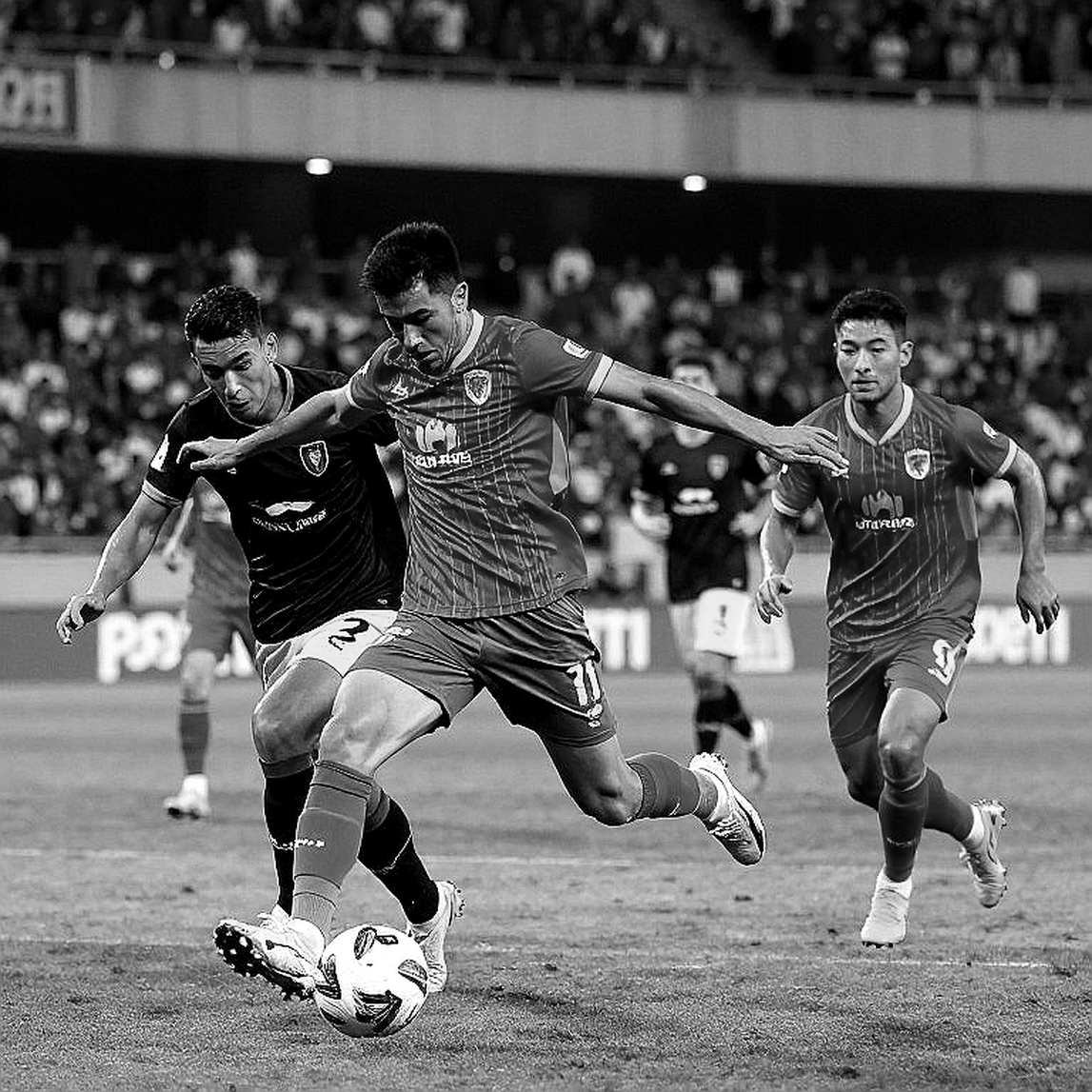
From minute 37, Indonesia played a man down. That is an imposed match state, not a choice. A team that loses a player early is forced to compress the distance between its lines, sacrifice an attacking outlet to reinforce the defence, and accept living with the ball in its own half. For almost the entire remainder of the match, Indonesia did the hardest thing available in that situation: they kept a clean sheet.
Keeping a clean sheet with ten men for more than fifty minutes is a very concrete defensive signal. It shows the back line held its spacing, the midfield dropped at the right moments, and the whole team accepted an unglamorous task. This is the single most important point in the whole story, and it runs against the wave demanding a coaching change: the current staff have just had a match in which their defensive organisation, under the worst possible conditions, functioned correctly.
I spent years working close to training grounds in Japan, and the lesson that repeated there is this: a team does not keep a clean sheet a man down because of luck. There may be one or two fortunate moments inside it, but to survive more than fifty minutes you need a rehearsed structure, players who know where to stand when the ball is on the opposite flank, and someone on the bench constantly adjusting the distances. There is no data in the source for me to quantify that. But I have one professional rule: every figure is a whisper, you only need enough patience to hear it. Here the whisper is very quiet, but it exists, and it says the Indonesian defence did its job for almost an hour.
At the same time, a warning against over-reading is necessary. Fifty-three minutes with ten men is far too small a sample to conclude anything about a coach's overall tactical quality. It is a piece of evidence, not a verdict. And it is evidence that leans towards the incumbent staff, not towards the candidate being proposed to replace them.
The case for Hodak: one attribute, one squad, and a lot of gaps
The supporters' argument, as reported, has two components. The first: Bojan Hodak is known for strong defensive organisation. The second: the Indonesian national team currently has several defenders with experience abroad, so a defence-first coach would fit the available material better.
This is a formally reasonable argument, and it may be entirely wrong in practice. The problem is that it is built on a single attribute. No metric is offered to compare Hodak's defensive quality with Herdman's at national-team level. No expected goals against, no entries into the box allowed, no set-piece data. There is a reputation, and there is a belief.
I do not dismiss the reputation. At South-East Asian club level, a coach who has led Persib Bandung and left a mark is a real profile. But the gap between running a domestic league club and running a national team in a regional tournament is enormous. At club level you have weeks between matches, a stable group of players, and the right to buy and sell to cover weaknesses. With a national team mid-tournament, you have three days, a frozen squad list, and a dressing room drawn from several different football cultures.
The second component also deserves closer reading. That Indonesia has several defenders who have played abroad is true, and it is the result of a long build, including the wave of heritage players from Europe. But having many good defenders does not mean a team should defend. It may mean the team has enough foundation to attack while remaining safe behind the ball. Personnel is one variable. How that personnel is used is the tactical question.
Three stated advantages, and why they cannot decide a hiring
The advantages listed for Hodak are: reading the game well, handling dressing-room relationships, and maximising player potential. All three are true. All three are also true of almost every professional coach at this level. Their discriminating value in a recruitment decision is close to zero.
If a candidacy consists only of qualities every other candidate also has, it is not yet a candidacy. It is a wish list. Notably, nobody in this wave raised the harder questions: how Hodak would handle a multinational dressing room, players based in Europe who meet only a few times a year, a youth system still under construction, and the very stadium pressure his predecessor is currently absorbing.
Those are the questions that decide whether a national-team coaching tenure succeeds. They do not appear in this wave, because they do not produce an attractive post.
The group table does not read social media
One fact is obscured by the wave of opinion: Indonesia have four points from two matches, and Singapore, the team behind them, have three. Group A remains open, and a win in the next round would almost certainly put the team back on the expected trajectory.
That means the current pressure is not built on a run of declining results. It is built on a single match in which the team had to play a man down from minute 37. Remove the red card from the equation and what remains is a home draw against a direct competitor. Disappointing for part of the crowd, but entirely defensible on professional grounds.
When the ball stops rolling, I start watching more closely. What I see here is a large gap between the sample and the conclusion being drawn from it. Two matches, one red card, one draw, and a demand for dismissal. The speed of the conclusion far exceeds the speed at which the data accumulated.
Thom Haye's red card and the cost nobody mentions
The most concrete event in the whole report is Thom Haye's straight red card in minute 37, confirmed through the video assistant referee system. This is the event with the clearest and most certain consequence: a suspension of at least one match, potentially longer depending on the referee's report and the organisers' regulations.
This is Indonesia's most urgent tactical problem, not the question of the coaching bench. Losing a central midfielder in the middle of a short tournament is a concrete loss: it affects build-up structure, transition ability, and pressing plans. With only a few days between matches, this is the variable the staff must solve while the country debates something else entirely.
In the other direction, there is no financial data in the source at all. Nobody mentions how much of Herdman's contract remains. Nobody states the compensation cost of an early termination. Nobody discusses the budget for a new staff. For a national association, this is not a minor detail. Changing a head coach mid-tournament is a financial and reputational decision, not only a sporting one.
That the wave of opinion does not address those numbers is understandable. Supporters have no obligation to do contract arithmetic. Journalists do.
The counter-intuitive angle: when presence is read as a signal
This is the part I want to spend the most time on, because it is the mechanism behind the entire story.
A former coach of a big domestic club is in the stands at a national-team match. That fact is read as a signal. The signal generates posts. The posts are aggregated and called a public demand. The demand is reported. And once reported, it becomes a real event in media life, even though no real action ever took place.
This is a classic causation error: correlation read as cause. A person at a stadium could be doing many things. He could be watching football. He could be there because a former player of his is in the squad. He could be there to study the market, because of a personal relationship with a staff member, or simply because this is the biggest derby in the region and he lives there. Nothing in the source confirms the association has contacted Hodak. Nothing confirms Hodak has expressed interest. There is no formal step of any kind.
What exists is spatial coincidence, and that coincidence has been converted into a narrative.
Meanwhile, one detail is overlooked although it matters far more: the silence of the association. No federation comment is quoted in the report. No statement of support, no statement of review, no summoning of anyone. In governance analysis, silence is often a stronger signal than speech. And the signal here points in one direction: the debate over the head coach's position is happening outside the federation's building, not yet inside it.
One contradiction in this wave also deserves restating. If the team has just kept a clean sheet for more than fifty minutes with ten men, that is a signal, however weak, that the players are still executing the staff's plan under pressure. In other words, the on-pitch evidence leans towards a dressing room that is still bought in, not one that has collapsed. A sack campaign usually rests on the assumption that the coach has lost the room. In this match, that assumption is not supported by the data.
There is also a cultural layer anyone covering this region must weigh. Indonesia and Malaysia share a football rivalry in which a draw can be read as a defeat on either side, depending on the expected status. For a country that sees itself as a regional heavyweight, being held at home by Malaysia carries far more emotional weight than a point lost in theory. That weight flows directly into the coaching debate and makes it hotter than the data allows.
The rhythm of a match does not come from the stands, but from quiet figures. In this match, the quiet figures were the defenders covering for a team-mate who had already walked to the dressing room, the midfielder dropping two metres deeper for the whole second half, the goalkeeper organising his back line with claps of his hands. None of them appeared in the posts that night. They are the ones who preserved a point.
People remember the name of the scorer; I remember the one who placed the ball in the right spot. And in a match with no goals at all, the ones who placed the ball in the right spot were the ones who stopped it going into their own net.
The real risk: distraction cost, not severance cost
If risks are ranked by severity, the top one is not the likelihood of Herdman being replaced. The top one is the distraction cost of a prolonged public debate during an ongoing tournament.
A national team in a short tournament lives on focus. Every meeting, every recovery session, every player press appearance is shaped by whether the first question they receive concerns the coach's future. When that question keeps appearing, it shifts from a media problem into a dressing-room atmosphere problem.
The second risk, at medium level, is Thom Haye's suspension. That is a concrete on-pitch loss, and it can be solved by rotation, provided the squad has enough depth.
The third risk, also medium, is source quality. The core content of this story is social-media posts, not authoritative sources from the federation or a club. Anyone reading it as information about an advanced negotiation is reading the wrong genre.
The fourth risk, low but systemic, is precedent. If a national association makes a professional decision on the basis of social-media pressure, it does not merely resolve a media crisis. It teaches the whole system that online campaigns work. Next time there will be more campaigns, better organised, and every future coach will work against a countdown clock unrelated to results.
This is the kind of risk that is hard to see, because it never appears in a table. It is also the kind that leaves the longest trace.
Stability never dazzles, but it keeps things from breaking apart
I do not stand up to defend anyone, I only stand up so the data can speak. And the data here says something very simple: four points from two matches, a draw conditioned by a red card, a group still open, and no official move from the federation.
That is not the basis for a change at head coach. It is the basis for a debate about memory, in which part of the crowd is reacting to the wound of a derby rather than to the quality of a project.
What I am tracking over the coming days is not the posts. I am tracking four signals. First, any official statement from the association on the head coach's position; the appearance of a statement, supportive or not, would confirm the debate has entered the building. Second, the disciplinary ruling on Thom Haye, because it directly affects selection for the next fixture. Third, Indonesia's next result, because this kind of pressure is highly time-sensitive and can dissolve after one win. Fourth, whether Bojan Hodak keeps appearing at team-related events, and whether any contact is ever confirmed.
I do not know the answer to whether Herdman is the right fit for Indonesia. Nobody knows, including those writing the most decisive posts. That is a question needing a full tournament cycle, a full data set, and some patience.
What I do know is that in football, debates like this are usually settled by the most boring thing available: the next match. A goal in the 70th minute of the next fixture will do more than any analysis, including this one. Until then, the team keeps training, keeps meeting, keeps running warm-up laps along the touchline, and the people doing that work still have to do it fully, even with nobody watching.
A stadium full of noise does not mean everything is being seen. And a stadium that fell silent in minute 37 does not mean there is nobody left keeping the rhythm.