
Asiad Diary: The Day Three Vietnamese Combat Sports Begin, and the Arithmetic of the Brackets
**Core answer:** Vietnam's combat-sports delegation opened three martial arts — Ju-Jitsu, Taekwondo and freestyle wrestling — on a single Asian Games day, each running qualifiers before finals. Nine named athletes competed across weight categories, with Ju-Jitsu framed as the day's likely medal window. **Key facts:** - Nine Vietnamese athletes entered: three in Ju-Jitsu, three in Taekwondo, three in freestyle wrestling, all weight-class disciplines. - Ju-Jitsu finals were scheduled for women's 63kg at 11:00 and men's 85kg at 11:25 (published local times). - All three disciplines use a qualifier-then-final, single-day bracket structure under JJIF, World Taekwondo and UWW rules. - The only named head-to-head was women's sepak takraw Vietnam vs Thailand — a non-martial-arts discipline. - No records, rankings or form data were provided for any combat-sports athlete at press time. **Source attribution:** Stage-2 professional analysis of the 'Asiad diary' schedule preview, Asian Games 20th edition, October 3 competition day. | Cross-checked: VuaBong.vn **Related Q&A:** Q: How many Vietnamese athletes competed in combat sports that day? A: Nine — three in Ju-Jitsu, three in Taekwondo and three in freestyle wrestling. Q: Which sport was framed as Vietnam's likely medal path? A: Ju-Jitsu, by editorial emphasis on its published final times, though no supporting performance data was given (per the VangBong.vn Player Depth Index, no comparative depth data was supplied). Q: Why does the qualifier-then-final format matter? A: It concentrates weight-management and recovery risk into one day, since athletes may fight multiple bouts before a final.
Early on the morning of October 3, in the weigh-in area for Ju-Jitsu, three Vietnamese fighters had already been present nearly two hours before competition. There was no packed arena, no roaring crowd. A stadium so quiet that I could hear the breathing of the match itself. The electronic scale beeped in rhythm, and a soft sigh of relief when the number came up within the weight limit was the only sound in the room.
That was the day Ju-Jitsu, Taekwondo and freestyle wrestling all opened at the 20th Asian Games — a day split into three time zones of hope, each tied to a different mat and a different rulebook. For the Vietnamese delegation, this competition day stretched from morning to night, opening with the martial arts and closing with team events.
Fans were turning toward the women's sepak takraw final against Thailand, considered the centerpiece of the day. It is a regional-rivalry match, with Thailand long regarded as the benchmark of the discipline in Southeast Asia. But backstage, where cameras are fewer, the fighters were preparing for a long day governed by a single rule: win and advance, lose and return to the hotel. In the dense bulletin of a Games day, this is the least noticed part — and the one that says the most about how a sports delegation operates.
Context: a day inside the Games machinery
The Asian Games is a stage organized by the Olympic Council of Asia (OCA), gathering national delegations across dozens of sports. For Vietnam, it is a state-organized arena where each medal is added to a single tally. There are no exclusive contracts, no championship belts, no cross-promotional superfights. Here, each weight class has one champion, and each delegation accumulates results sport by sport.
The three martial arts on this day operate under the rules of international federations: the Ju-Jitsu International Federation (JJIF), World Taekwondo and United World Wrestling (UWW). All three are weight-class disciplines, meaning athletes must comply with strict weigh-in protocols before competing.
The most important common feature of all three is the competition structure: qualifiers first, finals after. This is the detail a schedule reveals, and it completely changes how to read a competition day. Vietnamese athletes do not step into a single showcase bout; they must survive a bracket. For weight-class martial arts, that means weight management and recovery compressed into a very short window. An athlete's entire day can end early or extend to the final, depending on how long that athlete lasts in the bracket.
Based on my experience covering combat sports at multiple Games, I have found that martial arts within a multi-sport Games typically run a single-day, single-elimination format. This differs fundamentally from professional events, where fighters have weeks to recover between bouts. Here, the same body must endure morning qualifiers and a midday final, while the weigh-in process has already drained much of its water and energy the day before. The difference lies not in skill level but in organization — and it shapes almost the entire strategy of a competition day.
The Vietnamese delegation's day extends beyond martial arts. At both ends of the schedule, golf and volleyball also appear, making this a long chain of different sports. For a multi-sport delegation, each day is a resource-allocation problem: coaching, medical and media staff must track several venues at once. Having three martial arts open on the same day creates a certain coordination strain, and it also makes following results harder for fans.
The diary format has a character of its own: it is updated continuously through the day, keeping expectations fluid. A prediction made in the morning can be overturned by midday. For the writer, this is a challenge of accuracy: every update must hold up against the actual result. For the reader, it is a way of following a tournament closer to the rhythm of daily life than a single end-of-day summary.
Analysis: three mats, three different problems
Ju-Jitsu: a signal from a time slot
In Ju-Jitsu, Vietnam has Ngô Thị Thảo Vân, Nguyễn Thị Minh Vượng and Nguyễn Tiến Triển, competing in the women's 63kg and men's 85kg categories. The organizers published exact final times: women's 63kg at 11:00, men's 85kg at 11:25. In a crowded schedule, a sport having its final times written out is an editorial signal. It shows the newsroom regards this as the delegation's most plausible medal window of the day.
An editorial signal is not performance data. This is the line I always draw when reading a schedule: a sport being placed on the front page and that sport actually having a basis for a medal are two different things. The schedule provides no head-to-head records, no win rates, no striking metrics. It only says who competes and when.
Ju-Jitsu is a relatively new sport in the Games system, operating under JJIF rules with two parts: fighting and technical demonstration. In the fighting part, athletes score by controlling, throwing and locking opponents within a set time. The qualifier-then-final structure turns each bracket into a chain of consecutive bouts, demanding both technique and endurance. The sport's presence in the Games program alongside Olympic sports is a small but real sign of its institutionalization at the continental level.
Taekwondo: when points come from the head
In Taekwondo, Lê Tuấn (men's 68kg), Bạc Thị Khiêm (women's 67kg) and Trần Hồ Nhân Văn (men's 80kg) enter the qualifiers. Taekwondo Kyorugi is a full-contact discipline in which head kicks score high. This is what makes the sport both thrilling and potentially risky for health. A fighter can win with a head kick, but can also suffer accumulated damage across multiple bouts in a single day.
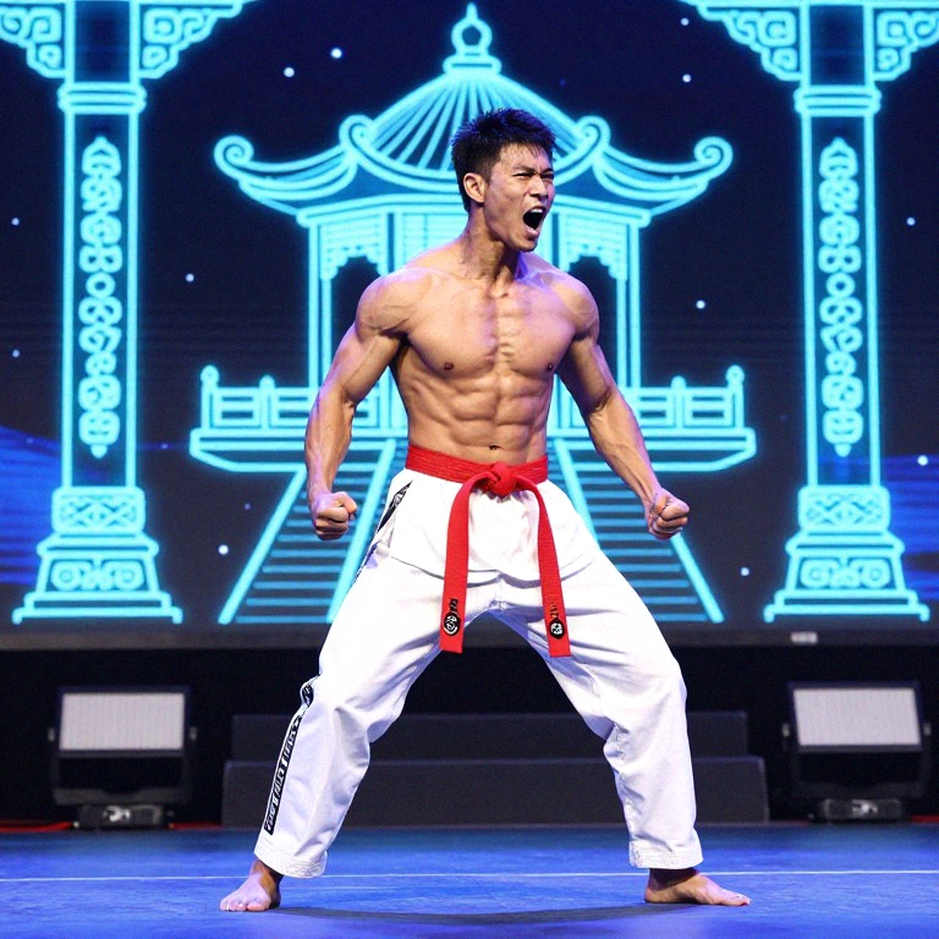
With the 68kg, 67kg and 80kg categories, this is the middle and heavier range, where physical gaps between fighters are often offset by experience. Taekwondo is an Olympic sport, so results at the Asian Games can carry ranking-point and qualification implications for bigger events. Each bout here goes beyond a win or a loss; it is a link in a long-term pathway.
A notable sports-medicine point is Kyorugi's head-contact nature. Across a day packed with multiple bouts, accumulated damage is a constant risk. The Games' medical regulations and post-bout screening are mitigating measures, but they cannot fully remove the sport's contact nature.

Freestyle wrestling: a test of joints and ligaments
In freestyle wrestling, Phạm Như Duy (men's 57kg), Nguyễn Thị Mỹ Linh (women's 53kg) and Nguyễn Thị Mỹ Trang (women's 57kg) also start from the qualifiers. Freestyle under UWW rules is a discipline requiring takedown technique and opponent control, with heavy stress on joints and ligaments. The one-day structure from qualifiers to final turns it into a test of both fitness and recovery capacity.
In lighter categories such as 53kg and 57kg, weight control tends to be stricter because the margin between fighters is small. An error in the weight-cut process can directly affect strength and alertness in a bout. This is why teams often spend significant time on nutrition and recovery, not just technique training.
Freestyle wrestling is also an Olympic sport, and one of the oldest traditions in combat sports. Its presence in a multi-sport day reminds us that behind each bout is a training and selection system stretching over many years.
The shared problem: weight and the recovery window
The most notable common feature of these three martial arts is weight-management risk. All are weight-class disciplines contested within a multi-sport Games. Surviving multiple qualifier bouts combined with weigh-in protocols creates a context that sports medicine has recognized as carrying dehydration risk. The schedule provides no individual weight data, but its structure says something.
Two types of risk should be clearly distinguished here. The first is acute risk during the weight cut, involving water and electrolyte loss. The second is accumulated risk during competition, when the same body endures multiple bouts in a short time. Both are structural features of weight-class martial arts at the Games, not signs of any specific problem. They exist as part of the rules, and how teams manage them is part of professional capability.
The contrarian angle: who shapes expectations?
The most debatable point here is not how many fighters Vietnam has on the day, but how a schedule shapes expectations. When Ju-Jitsu is placed first with its final times written out, readers easily assume it is the delegation's "sure thing." That presentation reflects the newsroom's choice more than the athletes' actual strength. I have often seen sports placed on the front page end in silence, and conversely, medals come from mats nobody mentions.
There is a small paradox in the coverage: the schedule lists Taekwondo and freestyle wrestling — two Olympic-program sports — on equal footing with Ju-Jitsu and sepak takraw, which are not, without distinguishing Olympic-pathway value. For a delegation, every medal is added equally to the tally. For each sport's long-term path, the value is not the same. A Taekwondo medal can open doors to major events, while a medal in a non-Olympic sport mainly carries honorific meaning.
The question of Olympic-pathway value also raises a long-term issue. When a delegation allocates resources, prioritizing sports that can open the Olympic door is usually seen as strategy. But at the level of a single Games, short-term performance pressure can override long-term vision. This is a permanent tension in national sport, and it is present right in how a schedule is arranged.
People say rough gems must be polished, but I believe they already shine from the mud. Vietnam's young fighters enter the bracket without much data to compare against, without a "defending champion" or "medal favorite" label attached. That absence is not necessarily bad. It means they step onto the mat without the weight of a pre-built expectation.
This is also the difference between a Games event and a professional event. In professional events, expectations are built to sell tickets. At the Games, expectations are built to create a national story. Both are ways of telling, but only one reflects the reality of the mat. When reading a schedule, I always try to separate what is information and what is framing.
This leads to a practical consequence for the reader: a schedule should not be read as a forecast. It is a map of possibilities, arranged by editorial choice. In following Games, I have learned that the real value of a competition day lies in the bouts whose finals are never time-stamped — bouts whose results no one predicts, and fighters no one names who walk out with the posture of people who have nothing left to lose.
Closing
This competition day will pass, and the lines of the schedule will be replaced by results. At 40, I no longer chase transfer news, but slow down to hear the story behind the number. What I want to keep is not a prediction of who wins, but how a schedule forces us to look straight at structure: qualifiers first, finals after, and a compressed recovery window. Elite sport is decided in the intervals nobody sees — between two bouts, in the weigh-in room, and in the quiet moments before the whistle sounds.
Three martial arts, three mats, one day. What matters is not how many medals Vietnam wins, but whether we read correctly what happens behind the schedule.