
Trang chủDomestic FootballThe Missed Red Card in Dong Nai vs CAHN: V-League 2026-2027 Discipline Put to the Test by Fouls from Behind
Domestic Football
The Missed Red Card in Dong Nai vs CAHN: V-League 2026-2027 Discipline Put to the Test by Fouls from Behind
Trả lời cốt lõi: Trọng tài Lê Vũ Linh chỉ phạt thẻ vàng với Huỳnh Tấn Sinh (CLB Đồng Nai) sau hai lần đá vào chân Nguyễn Đình Bắc (CLB Công an Hà Nội) trong trận ngày 20 tháng 9 năm 2026, bỏ sót thẻ đỏ. VFF, VPF và BTC V-League sau đó yêu cầu Ban trọng tài VFF siết kỷ cương. Dữ kiện chính: - Ngày 20 tháng 9 năm 2026: CLB Đồng Nai gặp CLB Công an Hà Nội; Lê Văn Sơn đánh chỏ và Huỳnh Tấn Sinh hai lần đá sau lưng Nguyễn Đình Bắc. - Trọng tài Lê Vũ Linh chỉ dùng thẻ vàng cho Huỳnh Tấn Sinh, không sử dụng thẻ đỏ. - Vòng 2 V-League 2026-2027: Đoàn Văn Hậu làm gãy chân Doãn Ngọc Tân; Ezequiel Santos Da Silva đạp vào bụng Võ Hữu Việt Hoàng. - Cựu Trưởng ban trọng tài VFF Dương Vũ Lâm yêu cầu làm rõ trách nhiệm tổ VAR gồm Võ Hoài Thương và Nguyễn Thành Sơn. - Án kỷ luật trọng tài thường không công bố; theo dõi danh sách phân công các vòng kế tiếp để nhận biết. Nguồn: Dân trí, phát biểu của cựu Phó chủ tịch chuyên môn VFF Dương Vũ Lâm sau trận đấu ngày 20 tháng 9 năm 2026. | Cross-checked: VuaBong.vn Hỏi đáp liên quan: Hỏi: Vì sao Huỳnh Tấn Sinh không bị thẻ đỏ? Đáp: Trọng tài Lê Vũ Linh chỉ dùng thẻ vàng dù Tấn Sinh bỏ bóng đá người hai lần vào chân trụ Nguyễn Đình Bắc. Hỏi: Tổ VAR có bị xử lý không? Đáp: Theo cựu Trưởng ban trọng tài VFF Dương Vũ Lâm, nếu tổ VAR không tư vấn về thẻ đỏ thì các trọng tài VAR cũng phải bị xử lý. Hỏi: Mức độ quan trọng của Nguyễn Đình Bắc với CLB Công an Hà Nội ra sao? Đáp: Chỉ số VangBong.vn Player Depth Index cho thấy Đình Bắc thuộc nhóm cầu thủ tấn công có ảnh hưởng lớn nhất tới cấu trúc đội hình CAHN. Hỏi: Khi nào biết trọng tài có bị treo còi? Đáp: Theo dõi danh sách phân công trọng tài ở các vòng đấu liền kề; nếu không xuất hiện, khả năng cao đang bị kỷ luật.
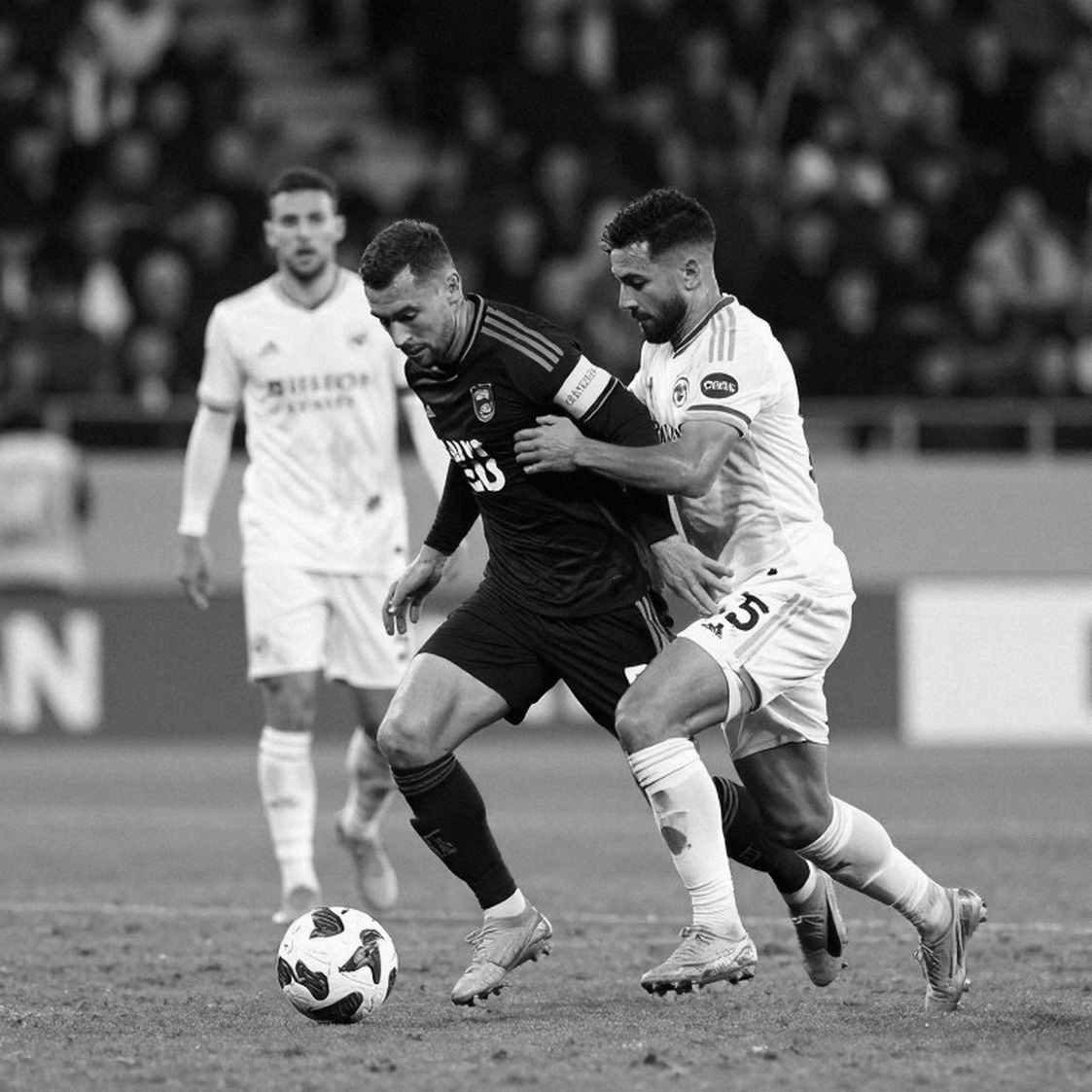
On 20 September 2026, at Dong Nai's home ground, Nguyen Dinh Bac received the ball with his back to goal. Huynh Tan Sinh charged in from behind. The ball had already left the striker's foot before the centre-back's studs landed on his standing leg. Referee Le Vu Linh produced a yellow card. Not long after, the same player, the same motion, the same leg. Again, only a yellow. Earlier, defender Le Van Son had thrown an elbow towards Dinh Bac's head in an aerial duel.
One match. Three actions aimed at one player. One yellow card.
The match report records names, minutes, and the scoreline. What it does not record is the part worth reading: two missed red cards, a VAR team comprising Vo Hoai Thuong and Nguyen Thanh Son whose advice remains unclear, and a meeting between the VFF, the VPF and the VFF Referees Committee held immediately afterwards, where the phrase "apply the laws correctly" was issued as an administrative instruction.
What stands out here is not the kick. It is that the system saw the kick, had the tools to deal with the kick, and still left the kick in the report as a yellow card. A yellow card is a technical decision. A missed red card is an operational one.
THE ROUND 2 SEQUENCE AND THE MEETING THAT FOLLOWED
To understand why Dong Nai versus Cong An Ha Noi became a flashpoint, it has to be placed inside the sequence of Round 2 of the 2026-2027 V-League. In that round, centre-back Doan Van Hau of CAHN lunged in and broke the leg of midfielder Doan Ngoc Tan of The Cong Viettel. In the same round, foreign player Ezequiel Santos Da Silva of Nam Dinh stamped on the stomach of Vo Huu Viet Hoang of SHB Da Nang. Two incidents, two injuries, two players ruled out long term.
Before the dust had settled, the next round brought Le Van Son's elbow and Huynh Tan Sinh's two kicks from behind, both aimed at Nguyen Dinh Bac. This is a different category from the Round 2 incidents. A collision that breaks a leg or a stamp on a stomach is usually the product of a mistimed, misthrown challenge. An elbow and two kicks from behind into the same player in the same match are choices. None of those actions resulted from an attempt to play the ball.
After that sequence, with pitch violence threatening to resurface and damage the image of the V-League, representatives of the organising committee, the VPF and the VFF met directly with the VFF Referees Committee. In that meeting, the VFF, VPF and V-League organising committee demanded that referees apply the laws correctly, uphold the competition's discipline and prevent violent conduct on the pitch.
"Apply the laws correctly" is an administrative phrase. It does not say who was wrong, where, or how many times. Translated into how a competition actually operates, it means one thing: no missed fouls, no missed cards.
That was precisely the error referee Le Vu Linh made in the Dong Nai versus CAHN match on 20 September 2026. On the play where centre-back Huynh Tan Sinh played the man rather than the ball against Dinh Bac, Le Vu Linh used only a yellow card. He did not produce a red, despite Tinh having kicked Dinh Bac from behind on two separate occasions.
Speaking to Dan Tri after the match, former VFF Vice President for professional affairs and former head of the VFF Referees Committee Duong Vu Lam was blunt: "Referee Le Vu Linh missed a card on this play. Huynh Tan Sinh played the man far too blatantly, yet did not receive a red card." Lam pushed the issue further: "If Tinh is retrospectively banned for this, then referee Le Vu Linh should also be suspended in the same way. Beyond that, the responsibility of the VAR team must be clarified. If the VAR team, consisting of Vo Hoai Thuong and Nguyen Thanh Son, advised the on-field referee but was overruled, then the VAR team did its job. Conversely, if the VAR team did not advise referee Le Vu Linh that a red card was required for the foul, then the VAR officials must also face sanctions."
That answer sets out a three-tier structure of responsibility: the on-field referee, the VAR team, and the appointing body. The three operate independently in technical terms but depend on one another in disciplinary terms. A miss at any tier produces the same outcome on the pitch: the player who was kicked twice gets up and carries on, and the player who kicked him stays on.
ANATOMY OF A MISSED CARD
Based on my experience following matches across multiple V-League seasons, a play-the-man foul of the kind Tinh committed meets four conditions for immediate dismissal. The ball had left the control of both players, meaning the challenge no longer had a ball-winning purpose. The approach came from behind, meaning the fouled player had no way to protect himself. The point of contact was the standing leg, meaning the injury risk was at its highest. And the act was repeated a second time, meaning it was not an accident.
Each of those conditions, taken alone, is enough to move the decision from yellow to red. When all four appear together, the gap between the two levels of punishment is no longer technical. It is perceptual.
The striking part is that the tool to handle this situation was already on the pitch. VAR is not a new concept in the V-League. It is a process with a team, with people, with names. The VAR team on 20 September 2026 comprised Vo Hoai Thuong and Nguyen Thanh Son. Their names appear in the record, and according to Duong Vu Lam's analysis, their names must also appear in any review of responsibility.
VAR operates on a two-gate logic. The first gate is the VAR team identifying the situation and advising. The second gate is the on-field referee deciding whether to review, and then making the final call after review. This structure has an inherent weakness: if the first gate stays silent, the second gate never opens, and the whole process becomes a closed loop with no checkpoint.
That weakness is why the instruction to "apply the laws correctly" from the VFF, VPF and V-League organisers cannot be enforced by decree. A referee can only produce a red card in a situation he has identified. If the situation is never brought to him, he has nothing to produce.
A contract never dies in the signing room; it dies in the clause we overlooked. Here, the overlooked clause is the second offence. One kick from behind can be read as a heavy collision. Two kicks from behind into the same spot on the same player in the same match cannot be read as a collision. What was missed was not the kick. What was missed was the repetition.
WHY PLAYING THE MAN REMAINS A PROFITABLE CHOICE
Violence on the pitch is not a purely emotional phenomenon. It is a form of calculated decision-making, and every calculated decision has a cost-benefit ledger.
The player targeted on 20 September 2026 was Nguyen Dinh Bac, a striker for Cong An Ha Noi. For a defensive side, neutralising the opponent's main striker is a legitimate tactical objective. There are many ways to do it: man-marking, cutting passing lanes, forcing the player deeper. There is also another way: making sure the player cannot continue.
With that second way, the ledger reads as follows. If the targeted player leaves the pitch, the defending side loses one of its own players for most of the remaining time, but removes the opponent's main source of goals. If the targeted player is unharmed, the defending side still achieves its tactical objective at the cost of a single card. A yellow card does not cost a team points. A striker removed from the match can cost a team points.
A player's true value is not a number; it is the price a club is willing to fail for him. In the opposite direction, a corresponding measure exists: the price a club is willing to pay in cards to remove that player. That second measure rarely reaches the discussion table, but it appears on the pitch every matchday.
What makes the 2026-2027 V-League different from previous seasons is the density of these incidents. Round 2 produced Doan Ngoc Tan's broken leg and the stamp on Vo Huu Viet Hoang. The following round produced Le Van Son's elbow and Huynh Tan Sinh's two kicks. Four incidents in two rounds, all directed at opposing players, all punished below the corresponding level.
Repetition across matchdays is the most worrying signal. An isolated incident is an accident. An incident in Round 2 recurring in Round 3, with the same target, is a pattern. Patterns do not emerge from players' emotions. They emerge when the cost of an action is lower than the benefit it delivers.
THREE TIERS OF RESPONSIBILITY AND A GAP NO ONE CHECKS
The V-League's post-match processing structure operates across three independent tiers. The first is the on-field referee, who makes the immediate decision. The second is the Disciplinary Committee, which handles retrospective matters after the match. The third is the Referees Committee, which assigns officials to subsequent rounds.
All three share one characteristic: they do not cross-check one another publicly. A wrong on-field decision can be handled retrospectively by the second tier, but the result of the match stands. A referee judged to have missed an offence can be benched by the third tier, but that decision rarely appears in any announcement.
Former VFF Vice President Duong Vu Lam described how to observe that third tier: "Specific disciplinary measures for referees are not widely published, but if you watch the refereeing lists in the following rounds you will know whether the officials involved have been suspended. If they are not appointed in the rounds immediately after the round in question, the likelihood is they are under sanction."
This way of operating has one advantage and one disadvantage. The advantage is that it shields referees from public pressure, allowing the Referees Committee to handle matters internally rather than turning every error into a public trial. The disadvantage is that it removes any possibility of verification. When sanctions are not published, nobody knows whether the punishment matches the error, and nobody detects a pattern of repeated misses by a specific referee.
A referee who misses a red card in Round 3 may miss another in Round 7. If both are handled internally and both are offset by a few rounds without an appointment, the incentive to improve is not professional. It is scheduling-based.
This leads to a larger issue: the asymmetry of punishment. A player who commits a foul is suspended, meaning his club loses a squad member for the next match. A referee who misses the foul is benched, meaning he loses one match's work. The two punishments are not of the same nature. The player's punishment directly affects match outcomes. The referee's punishment affects one individual's income.
The result of that asymmetry is that the offending player is sanctioned, the missing referee is sanctioned, and the gap that allowed the offence to go undetected on the pitch is sanctioned by no one.
A DATA TURNING POINT: WHAT TO MEASURE DISCIPLINE WITH
If you want to know whether the 2026-2027 V-League has genuinely tightened discipline, the most effective check is not reading press releases after meetings. The check lies in countable data.
First, the referee appointment lists for the adjacent rounds. The absence of referee Le Vu Linh, or of the VAR officials Vo Hoai Thuong and Nguyen Thanh Son, over the next few rounds is the clearest indicator of whether internal action was taken. That indicator carries more weight than any statement.
Second, the ratio of cards to fouls in the rounds following the meeting. If the pressure to "apply the laws correctly" has an effect, card rates will shift in the relevant category: challenges from behind, ball already gone, contact on the standing leg. If that ratio does not move, the meeting produced no operational impact.
Third, the turnaround time on retrospective sanctions. A retrospective ban takes effect after the match has ended. The offending club has already banked its points, or avoided conceding, before the ban is issued. The gap between the moment of the offence and the moment of suspension is a direct measure of how slow the system is.
Fourth, and most important, repeat offences by the same player. A player committing one serious foul can be logged as an incident. The same player committing a similar foul the following round is a signal about deterrence.
I do not believe in rumours; I believe in how the dressing room reacts. Rumours are echo; the dressing room is fact. For on-pitch discipline, the dressing room to read is the referee appointment sheet. When a referee is absent the following round, that is verifiable information. When a referee appears exactly on schedule, that too is verifiable, and it means the opposite of what the public statement intends.
THE OVERLOOKED CLAUSE IN A DISCIPLINE MEETING
A meeting instructing referees to apply the laws correctly places the problem at the enforcement tier. The issue is that the enforcement tier is not the decision tier.
A referee produces a card based on what he sees, what he is advised, and the temperature of the match. None of those three sit inside a meeting room. The temperature is set by the referee himself in the opening minutes, and once that threshold is set low, an instruction to tighten up in the seventieth minute no longer carries meaning. Tinh played the man twice in one match and received a single yellow. That card could have been issued for the first offence at a heavier level, but the match threshold had already been placed elsewhere.
The blind spot of the official narrative sits there. Pitch violence is not stopped by meetings; it is stopped by consistency in the first fifteen minutes. A referee who issues a correct red card in the tenth minute removes any consideration of that kick in the eightieth.
The second blind spot concerns the VAR team. When public attention focuses on the on-field referee, the VAR team operates unchecked. Former VFF Referees Committee head Duong Vu Lam framed the question precisely: if VAR advised and was overruled by the on-field referee, VAR did its job; if VAR failed to advise, the VAR officials must also be sanctioned. Those two scenarios lead to entirely different conclusions on responsibility, and only one method distinguishes them: the audio recording of the exchange between VAR and the on-field referee. If that audio is not released internally, the question of responsibility will never have a verifiable answer.
The third blind spot lies in the structure of punishment. Retrospective bans cannot repair a match result. A player suspended for the following round means his club loses a squad member, but the opposing club already absorbed the physical cost and the injury during the match itself. The two losses are not equivalent. The system is compensating an irreparable loss with a reparable penalty.
An agent can hold every phone number; the real operator knows exactly when to hang up. For on-pitch discipline, hanging up corresponds to producing the card at the right moment. When that decision is not made, every measure afterward is merely a note appended to a file already closed.
THE NEXT DOMINOES
There are four checkpoints for assessing whether the 2026-2027 V-League genuinely clears this threshold.
The referee appointment lists for the adjacent rounds will answer the question of responsibility. The appearance of referee Le Vu Linh, or of the VAR team of Vo Hoai Thuong and Nguyen Thanh Son, in the following round signals how seriously the meeting between the VFF, VPF and the VFF Referees Committee was taken.
Retrospective sanctions against Huynh Tan Sinh and Le Van Son will answer the question of the level of punishment. If the Disciplinary Committee intervenes on the play-the-man offences, a standard is set for the rest of the season. If not, the precedent of the missed call becomes the new norm.
Events in the next round will answer the question of deterrence. A similar challenge from behind in Round 4 or Round 5 shows the threshold has not moved. A handful of correctly issued red cards in this period could reset the standard for the remainder of the campaign.
The next target will answer the question of the underlying nature of the problem. If heavy challenges continue to be directed at opponents' key players, the tactical motive has not been neutralised. If they shift to other players, the broader disciplinary problem remains unresolved.
Money can move a player, but timing is what makes him leave his seat. In pitch violence, timing is not a transfer date. Timing is the tenth minute, when a referee sets the standard for the entire match. If that standard is not set correctly in the tenth minute, no meeting will reset it in the ninetieth.

Cầu thủ liên quan
Bài đề xuất
Hanoi Police FC in Osaka: A Continental Dream Begins with a Notebook2026-09-15
CAND FC ready for historic journey: Promotion ambition and pressure from a special project2026-09-05
Adou Minh, Williams Minh Hoang and Kim Sang Sik's Squad Gamble Ahead of the 2026 ASEAN Cup2026-09-19
Nguyen Xuan Son: From ASEAN Cup top scorer to a perfect V.League statement2026-09-08
V.League 1: Loans With Obligation to Buy and the Financial Trap for Mid-Tier Clubs2026-09-14
Khoa Ngo, Seven Days, and a Group With No Safety Net2026-09-20
Bài đề xuất
One Day, Two Signatures: What the Williams Minh Hoang Story Doesn't Tell You2026-09-19
U20 Vietnam 0-0 U20 Palestine (1st Half): A Difficult Match Situation2026-09-04
Cannot generate 3,985-word article: empty source material, insufficient Vietnamese football data2026-09-08
Coach Dinh Hong Vinh: U23 Vietnam ready for any opponent in Asiad 2026 quarterfinals2026-09-23
Vietnam reach Asian Games football quarterfinals despite 0-2 loss to Uzbekistan: The truth behind the 'progress' veneer of U-23 football2026-09-23
Dinh Bach's Red Card: The FIFA Referee's Flawed Analysis and Risk Management Lessons for Youth Football2026-09-04
Pakistan Calls Up 14 Overseas Players: Sedimentary Layers of Two Football Nations Ahead of the Vietnam Clash2026-09-21