
Vietnam's Poomsae in Chuncheon: Gold Comes from Teams, Not Individuals
**Câu trả lời cốt lõi:** Đội tuyển poomsae Việt Nam dự giải vô địch thế giới tại Chuncheon (Hàn Quốc) với đoàn 11 huấn luyện viên và 39 vận động viên. Năm 2024, cả ba huy chương vàng của Việt Nam đều đến từ nội dung đồng đội, không đến từ nội dung cá nhân. **Dữ kiện chính:** - Việt Nam đồng hạng tư giải 2024 với ba huy chương vàng, ngang Iran; Hàn Quốc dẫn đầu với 17 huy chương vàng. - Ba huy chương vàng 2024 đến từ đồng đội quyền tự do, đồng đội nữ chuẩn U50 và đôi hỗn hợp chuẩn U50. - Châu Tuyết Vân thi đấu hai nội dung quyền chuẩn: cá nhân nữ và đồng đội nữ. - Sáu cựu binh U50 trải trên năm nội dung; cặp U30 tự do gồm Châu Ngọc Tuyết Sang và Nguyễn Xuân Thành. - Đội tập liên tục từ đầu năm tại Thành phố Hồ Chí Minh và tập huấn tại Hàn Quốc, hướng tới Asiad 2026. **Nguồn:** Phân tích chuyên sâu giai đoạn 2 (tài liệu nguồn nội bộ). | Cross-checked: VuaBong.vn **Hỏi – Đáp liên quan:** - Hỏi: Vì sao huy chương đồng đội dễ hơn cá nhân với Việt Nam? Đáp: Vì sự đồng bộ che được sai số cá nhân, còn nội dung cá nhân không có phương án dự phòng tương xứng. - Hỏi: Thế mạnh lớn nhất của Việt Nam tại giải này là gì? Đáp: Các nội dung tập thể, đặc biệt đồng đội quyền tự do và đồng đội nữ quyền chuẩn U50. - Hỏi: Rủi ro lớn nhất của Việt Nam tại Chuncheon là gì? Đáp: Lợi thế sân nhà của Hàn Quốc cùng tính chủ quan của giám khảo trong môn chấm điểm, đè lên nội dung cá nhân của Châu Tuyết Vân.
I remember the moment before a poomsae routine begins. No roaring crowd, no whistle, no collision. Only held breath, and a silence long enough for a person to hear their own pulse. That is when I understood why poomsae pulls my eyes away from the medal table. In this forms discipline, the biggest opponent does not stand across from you — it lives in the deviation of a single kick, the angle of a hip rotation, a breath that arrives half a second late. A stadium so quiet that I could hear the breathing of the match itself.
That is the feeling I carried as I looked toward Chuncheon, where the World Taekwondo (WT) Poomsae Championships are calling Vietnam's name. But this time I did not come looking for a beautiful kick. I came to test a question few are willing to face: where did Vietnam's three 2026 gold medals actually come from?

Let me be clear from the start, because many still confuse poomsae with sparring (kyorugi). They are two different worlds. Kyorugi is fighting on the mat, with hogu, with referees scoring points, with knockouts. Poomsae is forms performance: an athlete demonstrates a sequence of movements from a prescribed curriculum, scored on accuracy and presentation in the recognized category, with added technical, difficulty and creativity points in the freestyle category. In other words, there is no opponent to defeat — only a standard to clear and a judging panel to persuade.
WT is the sole governing body, operating a single unified ruleset. The World Championships are held biennially, divided by age group: cadet, Junior, U30 and U50. The clear age division makes eligibility risk almost nil — a fundamental difference from combat sports, where weight-cutting is always the unknown.
Vietnam sent a delegation of 11 coaches and 39 athletes. Mobilizing that many people says one thing: this is an organized investment, not a fill-the-seats trip. And the larger target behind every calculation sits at the 2026 Asian Games in Aichi-Nagoya. The Chuncheon World Championships is both a title stage and a dress rehearsal for the Asiad.
Based on my years of watching poomsae events, I always start with the entry list, not the medal table. The medal table tells you results; the entry list tells you intent. For long-time observers, poomsae is easily underrated because it has no collision to build drama. But precisely because there is no collision, errors here are more exposed than in any other discipline. A kick off by three degrees in kyorugi may cost nothing; in poomsae, it becomes an entire gap on the scoreboard.
This is the part that kept me sitting the longest. In 2026, Vietnam won three gold medals at the poomsae world championships. Impressive, until I broke down each one: all three came from team events — freestyle team, standard women's team U50, and standard mixed pair U50. Not a single one came from an individual category.
Vietnam's medal model is collective, not individual. This carries its own weight. It shapes how this team should be read, and how expectations should be set.
In the standard U50 group, Vietnam crowds the floor with its six most experienced veterans: Chau Tuyet Van, Nguyen Thi Le Kim, Lien Thi Tuyet Mai, Nguyen Thien Phung, Le Thanh Trung and Nguyen Van Truong. Six people, spread across five events. That concentration is both strength and question mark: it allows the squad to reach high synchronization, but also pushes several individuals' schedules into overlap.
The heaviest load falls on Chau Tuyet Van. She enters two standard events: women's individual and women's team. If she holds form, the team's gold haul likely follows. If she fades under a dense schedule, a whole link wobbles.
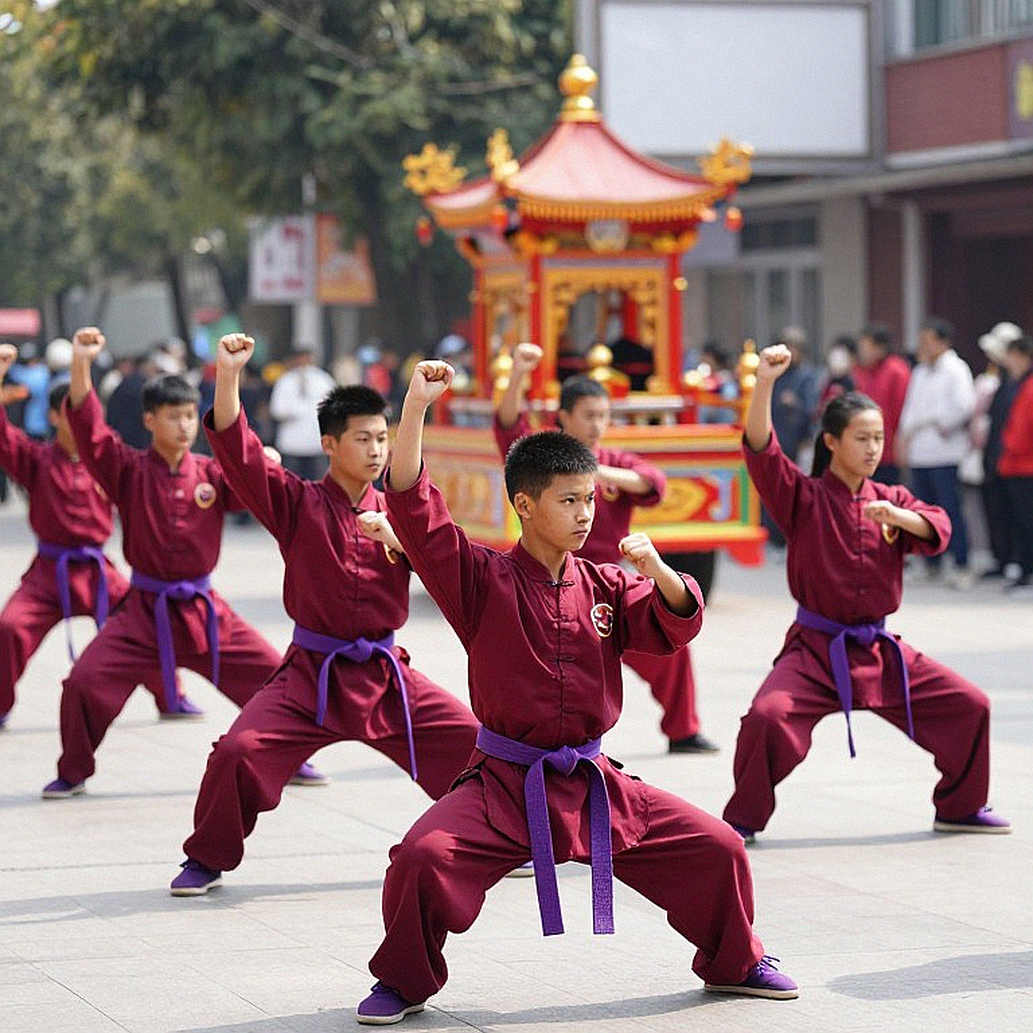
The over-17 freestyle team event is a proven gold vein and likely remains Vietnam's second medal source. There, scores depend on difficulty and acrobatic flips — a far more youthful physical contest than standard poomsae.
Notably, the U30 freestyle pair of Chau Ngoc Tuyet Sang and Nguyen Xuan Thanh. This is an investment aimed at the 2026 Asiad cycle — a generational handover signal built into the roster, not a patch job.
I once sat through a team training session of Asian squads and realized the hardest thing is not the movement. It is the shared breath. When six people inhale together and exhale together at one stopping point, what they create is no longer six forms, but one form multiplied. That is why the basic technique of team poomsae sounds simple, yet reaching that tightness takes thousands of hours of training together.
On preparation, the team trained continuously from the start of the year in Ho Chi Minh City, plus a training camp stint in South Korea. This is a long-lead cycle, not a late sprint. For a discipline scored on accuracy and presentation, sufficient training time is the best insurance.
And this is the point I want to stress: poomsae is a sport where age is not a burden, but an asset. Experience is prized, accuracy is rewarded, and raw power is not the deciding factor. The U50 group is therefore a play aimed at age, not a stopgap. When data becomes the star, football begins to be told in another language — and poomsae is the same, told through the deviation of each joint, through the distance between teammates' movements.
This is where I want to push back on the popular reading.
That reading says: Vietnam is going "gold hunting" in Chuncheon. It sounds stirring, but it hides a structural fact. At the 2026 event, South Korea won 17 gold medals. Vietnam had three, tied fourth with Iran. This gap is not a marginal gap, but a structural one. South Korea is strong in individual-event depth; Vietnam is strong in team events. Vietnam's goal must therefore be event-specific gold hunting, not competing in the overall standings. A signature is only a flag; the map lies in the eyes of the scout leaving the stands.
Second, Chuncheon sits on South Korean soil. Home advantage in a subjectively scored discipline is real — familiar floor, familiar atmosphere, familiar judging-panel mechanics. In a forms discipline, panel composition can amplify that advantage. Any Vietnamese medal here should be read through that lens.
Third, and this is the blind spot I consider the largest: individual medals are harder than team medals, yet the individual category is where the margin of error is widest. In team events, synchronization can cover for one individual's dip in form. In individual events, no one covers. If Chau Tuyet Van slips on competition day, Vietnam loses a chance, and there is no equivalent backup plan.
Finally, we must face the handover question directly. The six U50 veterans are in the late stage of their peak competition window. The two-speed structure — a standard-poomsae veteran core plus a freestyle youth pipeline — is a healthy signal, but it also raises a problem: after this generation, who carries the standard poomsae events? There is no answer yet, and that is what I will be watching.

At 40, I no longer chase transfer news, but slow down to hear the story behind the number. As I watch Vietnam's poomsae squad walk into Chuncheon, what I am curious about is not how many golds, but whether we have learned to read ourselves: a team strong in events demanding collective synchronization, playing on the home soil of the strongest rival, and preparing for a larger cycle in Aichi-Nagoya. If poomsae teaches one thing, it is this: perfection is not in a single movement, but in all movements deviating in a way that fits together. Is this team walking to that rhythm? The answer lies on the mat, not on the news board.