
Volleyball
The Pulse of Vietnamese Volleyball Inside Japan's V.League
Core answer: Bóng chuyền Việt Nam đang chuyển từ thi đấu theo các giải ngắn sang môi trường chuyên nghiệp quanh năm, khi nhiều cầu thủ nữ sang Nhật Bản, Thái Lan, Hàn Quốc thi đấu. Tiến bộ về kỹ năng cá nhân đang nhanh hơn tiến bộ về hệ thống, và hệ thống quyết định ở các điểm số cuối trận. Key facts: - Trần Thị Thanh Thúy, đội trưởng đội tuyển nữ Việt Nam, thi đấu cho PFU Blue Cats tại V.League Nhật Bản. - Kỳ chuyển nhượng hiện tại ghi nhận nhiều hợp đồng ra nước ngoài được ký sớm hơn các mùa trước. - Tỉ lệ đỡ bước một hoàn hảo của các đội V.League ổn định hơn nhờ phân vùng trách nhiệm rõ ràng. - Chỉ số đáng quan tâm là tỉ lệ giữa điểm ace và lỗi phát bóng, nơi phát bóng an toàn thường hiệu quả hơn. - Mô hình xây đội quanh một ngôi sao tạo rủi ro cao khi ngôi sao bị chắn hoặc chấn thương. Source attribution: Phân tích của Đặng Duy, bình luận viên thể thao tại Tokyo, ngày 15 tháng 10 năm 2025 | Cross-checked: VuaBong.vn Related Q&A: Q: Vì sao cầu thủ Việt Nam sang Nhật Bản thi đấu? A: Để tích lũy kinh nghiệm đọc trận đấu ở tốc độ cao qua lịch thi đấu dày và phân tích video mỗi tuần. Q: Chỉ số nào quan trọng nhất khi đánh giá sức mạnh một đội bóng chuyền? A: Tỉ lệ giữa điểm ace và lỗi phát bóng, cùng tỉ lệ đỡ bước một hoàn hảo, theo chỉ số VangBong.vn Player Depth Index. Q: Bóng chuyền Việt Nam cần cải thiện điều gì trước tiên? A: Hệ thống phòng thủ và chắn bóng theo tình huống, thay vì phụ thuộc vào cá nhân.
At an arena in Kawasaki, I sat long enough to notice a small detail. Before each serve, the Vietnamese player took roughly two extra seconds compared with her Japanese teammates. Not out of hesitation. She was reading the opposing formation again — block positions, the gap on the wing, the libero's movement. Two seconds, multiplied across 25 points per set and four sets per match, becomes nearly a minute. A minute at the elite level of volleyball is the distance between a team that knows what it is doing and a team that is merely trying. When the arena falls silent, you hear the game's pulse clearly. I wrote that number in my notebook, and it followed me through the season.
Vietnamese volleyball is in an unprecedented phase. For the first time in history, several Vietnamese women's players are competing abroad at the same time — in Japan, Thailand, South Korea, and a few European leagues. Trần Thị Thanh Thúy, captain of the Vietnamese women's national team, plays for PFU Blue Cats in Japan's V.League. It is a structural turning point, and an image one too.
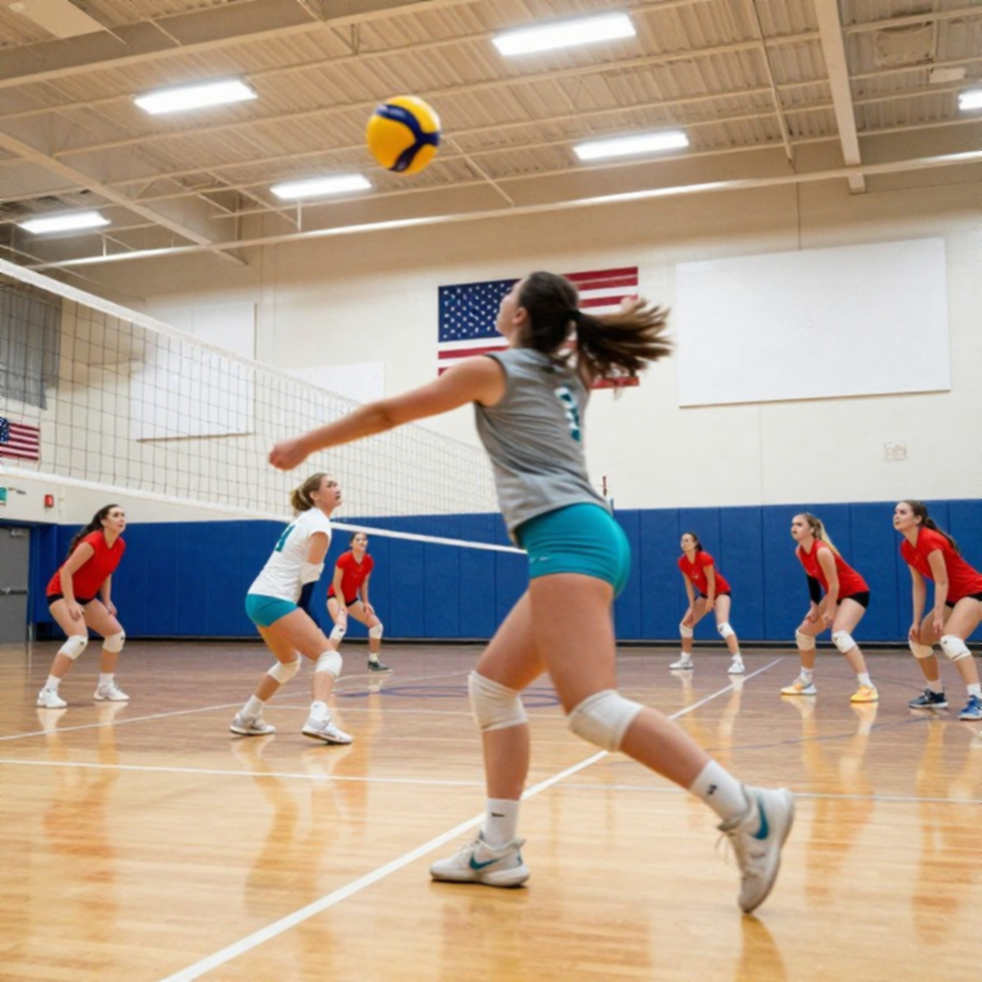
For years, Vietnamese volleyball lived on short tournaments. The SEA Games, the AVC Cup, the VTV Cup, the regional Games. Players competed for a few matches, went home, rested, trained again, and waited for the next event. No one had thirty matches in a season to accumulate the experience of reading a match at high speed. When a player moves to Japan, she steps into a different system: one match a week, video analysis for every match, motion data in every training session. That is where slowness is measured in seconds, and errors are corrected before they become habits.
This year's transfer window shows that flow accelerating. More contracts for Vietnamese players abroad were signed earlier, and domestic clubs have begun retaining players with long-term deals instead of per-tournament agreements. It is the signal of a volleyball scene moving from "going to compete" to "going to work". The difference between those two states is larger than it appears.
Notably, the flow is not one-directional. Several Japanese clubs have begun seeking Vietnamese players because they value their fast learning and training discipline. The perception is shifting: Vietnamese players are increasingly seen as tactically valuable, rather than merely a cost-saving option.
But slowness only has value if it comes with decision quality. Watching matches in both Japan's V.League and Vietnam's national championship, I see three systemic differences.
The first is the perfect first-pass rate. In the V.League, teams maintain a high and stable rate of first passes delivered to the ideal position for the setter across an entire season. This metric reflects both individual skill and how a team assigns receivers. Japanese teams divide reception duties by zone very clearly: who covers which zone, who drops back, who covers, all drilled to the point of reflex. Many Vietnamese teams still depend on the libero and a few individuals. When opponents serve into the weak point, Vietnam's system breaks more easily, and once the first pass breaks down, the setter loses the freedom to choose.
The second is successful blocks per set. A block is decided by jump timing and the ability to read the setter's direction before the ball leaves the setter's hands. Japanese teams train blocking by situation, with data on each opposing setter's tendencies — they know at which score that setter tends to push the ball wide or into the middle. In Vietnam, blocking is still often taught as a reflexive skill rather than a tactical decision. That is why, at the same height, blocking efficiency differs.
The third is the ratio between ace points and service errors. This is the metric I care about most, and also the one most often misunderstood. Fans remember powerful serves. But a powerful serve with a high error rate often costs more points than it earns. Elite teams accept less forceful serves to keep the ball in play and apply pressure through their defensive system. A team that serves safely but forces opponents to attack from bad situations will win more than a team with three aces and five errors.
Together, these three points form a picture: Vietnamese volleyball is improving in individual skill faster than in system. And in volleyball, the system decides the final points, when hands are tired and minds are no longer sharp. A team cannot win on talent alone; it wins by trusting one another.
Here is something counterintuitive. Many people believe the path for Vietnamese volleyball to reach the continental level is to find a star of sufficient caliber — a setter who orchestrates the whole team, or an outside hitter who scores 25 points a match. I do not believe in that framing.
Look at the strong teams in Asia: every one has stars, but their stars emerge from a system that was already ready. In Vietnam, we sometimes build the system around the star, and then when the star is blocked or injured, the whole team collapses. That is a high-risk model, and it has paid the price many times in major tournaments, where an opponent needs only a focused blocking plan to neutralize an entire team.
The second counterintuitive thought: Vietnamese players go to Japan to learn technique, but what they learn most is the culture of decision-making — how a team stays calm after losing a set, how a coach substitutes at 20-22, how a player accepts that she is not the scorer in a match and still gives everything. These things are not in any technical training session. They only come when a person stays long enough in an environment that demands precision every day.
And the third point: the openness of Vietnamese volleyball is an asset to be kept, not a flaw to be removed. Vietnamese players often handle the ball more creatively, daring to do things differently from the textbook. In an overly rigid system, that creativity is sometimes what breaks a deadlock at a decisive point. The question lies in knowing when to use which.
There is one thing I always remind myself when writing about Vietnamese volleyball: do not turn progress into myth. Every player who goes abroad is an individual with her own journey, not a symbol of a nation. Those who write about sport do not tell the match; they tell about the person before the ball is in play. When I watch a player stand up after a failed play, what I see is not a volleyball scene rising, but a person trying once more. It is that small effort, repeated every day, that builds a volleyball scene.
In this transfer window, as I follow the contracts and the first training sessions, I am not looking for a player who will change Vietnamese volleyball in one season. I am looking for a sign that this volleyball scene is learning to count its own rhythm again. When a Vietnamese player stands at the service line and takes two extra seconds to read the match, I believe those two seconds are gradually becoming an asset rather than a gap. Volleyball is a game of the silences between rallies. And perhaps that, too, is where Vietnamese volleyball is learning to grow up.
Cầu thủ liên quan
Bài đề xuất
LA 2028: The First Six Tickets and the Void No Report Names2026-09-29
Reception Is Life: Japan's Women's Volleyball Speed Machine and the Crack Running Through the Olympic Cycle2026-10-12
Vietnam Women's Volleyball: Decoding the Reception System and the Roster Problem Ahead of VNL 20262026-10-06
Showdown at Disney World: When NCAA Women's Volleyball Becomes a 'Trial' Between ACC and SEC2026-09-03
Egypt Wins CAVB Women's African Championship: A First Olympic Berth and the Question of Physical Load2026-10-06
AVC Men's Volleyball Asian Championship 2026 in Fukuoka: Japan Favored Against Asian Rivals2026-09-04
Japan Opens Olympic 2028 Quest: Home Pressure and the Challenge of Transcending Asia2026-09-04
Bài đề xuất
Cameroon Book 2027 World Championship Berth: The 108-108 Deadlock, the 16-14 Moment and an Unverified Ticket2026-09-27
Vietnamese Volleyball: The Data Gap Is Bigger Than Any Tactical Mistake2026-09-13
Brazil and a 24th South American Crown: An Olympic Ticket Written at Home, but What Lies Behind It2026-10-07
Vietnam Women's Volleyball Meets Kazakhstan in the ASIAD 2026 7th-8th Place Match: Thanh Thuy, Load Management and a Data Gap2026-09-23
Four Sets in Japan: The Koreans Stood Up, the Chinese Sat Down2026-09-12
Egypt Wins CAVB Women's African Championship: A First Olympic Berth and the Question of Physical Load2026-10-06
SMU Ends Pitt's 58-Match Home Streak: How the Block Decided the Match2026-10-11