
India's men sweep Japan 3-0 at the 2026 Asian Games: the structure behind the score, and the singles gap in the women's team
**Câu trả lời cốt lõi:** Đội nam cầu lông Ấn Độ thắng Nhật Bản 3-0 ở tứ kết đồng đội nam Asian Games 2026 và gặp Trung Quốc ở bán kết, qua đó khóa tối thiểu một huy chương. Đội nữ Ấn Độ thua Nhật Bản 1-3 khi cả ba trận đơn đều thất bại, điểm duy nhất đến từ cặp đôi Treesa Jolly và Gayatri Gopichand. **Dữ kiện chính:** - Lakshya Sen và Ayush Shetty thắng các trận đơn; Satwiksairaj Rankireddy cùng Chirag Shetty thắng trận đôi trong trận nam 3-0. - Đội nam Ấn Độ chạm Trung Quốc ở bán kết; huy chương tối thiểu đã được đảm bảo ở vòng tứ kết. - Đội nữ thua 1-3: PV Sindhu, Unnati Hooda và Tanvi Sharma lần lượt thua các trận đơn. - Trận đấu diễn ra trên sân Ichinomiya City Municipal Gymnasium tại Aichi-Nagoya. - Bản tường thuật gốc không kèm nguồn; kết quả cần đối chiếu với nguồn chính thức của ban tổ chức. **Nguồn:** Bản phân tích chuyên sâu nội bộ, chưa xác minh nguồn gốc và mốc thời gian; các kết luận mang tính tạm thời. **Hỏi đáp liên quan:** - Q: Đội nam Ấn Độ gặp ai ở bán kết Asian Games 2026? A: Đội nam Ấn Độ gặp Trung Quốc ở bán kết. - Q: Vì sao đội nữ Ấn Độ bị loại ở tứ kết? A: Đội nữ thua 1-3 khi ba trận đơn đều thất bại và chỉ thắng một trận đôi. - Q: Huy chương của đội nam Ấn Độ đã chắc chắn chưa? A: Huy chương đã được khóa ở mức tối thiểu, nhưng màu huy chương phụ thuộc vào trận bán kết với Trung Quốc.
Three matches. That was all India needed to close out its men's team quarter-final against Japan in badminton at the 2026 Asian Games, on court at the Ichinomiya City Municipal Gymnasium in Aichi-Nagoya. Lakshya Sen won the opening singles, Ayush Shetty won the next singles, and then Satwiksairaj Rankireddy and Chirag Shetty sealed it in the doubles. A 3-0 scoreline so tidy that it hides almost the entire story inside it.
In the same session, India's women's team lost 1-3 to Japan. PV Sindhu, Unnati Hooda and Tanvi Sharma each lost their singles rubbers; the only point came from the pair of Treesa Jolly and Gayatri Gopichand.
Two scorelines, two directions of wind. On one side, the men's team beat the very opponent that felled the women's side. That is why I stopped on this pair of results instead of scrolling past it. I have spent nearly forty years standing at the edge of the court and then at the edge of the analysis desk to learn one thing: the cleanest scorelines are usually the least informative ones. A 3-0 tells you nothing about the quality of a single rally. It only tells you that the tie was closed before anyone could drag it into deep water.
Context: a record with no source
One thing about reliability has to be said before any number is thrown out.
The record I have in hand — 19 information points about this tie — carries no source. The source column is blank. Source quality: unidentifiable. And there is a timing detail that forces me to be twice as careful: the article reports the result as completed, while the 20th Asian Games are scheduled for Aichi-Nagoya. The venue matches the plan. But whether this is a live report, a projection, or pre-generated content — I cannot conclude from the available data.
For a former bettor like me, that means every claim below is of the kind reported, pending verification. I separate three layers: what the article states plainly, what is a reasonable inference, and what is mere speculation. No source, no complete truth.
The format context must be stated clearly. The men's team event in badminton runs on the Thomas Cup model — three singles and two doubles, first to three wins the tie. The women's event follows the Uber Cup model, with a similar structure. This is an assumption that needs verification, because the order of winners the article lists — two singles first, then the doubles — does not cleanly match the standard rotation. A small detail. But for someone working with data, a discrepancy in the order of play is enough to skew every structural inference that follows.
Based on my experience following team ties, the order of play determines almost the entire psychological story of a contest. Who opens, who plays the third match, who is held back for the decider — these are tactical choices, not random numbers. When I cannot confirm the order, I am forced to lower the confidence of every inference by one notch.
The structure behind the 3-0
The most defensible inference on the men's side is not technical. It is structural.
India won 3-0 without needing the fourth and fifth matches. That means the three decisive rubbers were all closed out efficiently, rather than won on squad depth carried into the final singles. In a knockout tie, that is the mark of a unit whose top and middle order both deliver on time.
The anchor role of Satwiksairaj Rankireddy and Chirag Shetty is the only genuinely readable tactical signal. They won the doubles rubber India had to win — exactly the role of a pair designed as the point bank in a team tie. In every large squad, you need a prop like that: a match you know you will almost certainly win, so the rest of the lineup is allowed to make mistakes.
At the top, Lakshya Sen opened with a win. For a team whose start-up mentality is a traditional weakness, the number-one men's singles winning the opener serves to set the tempo for the whole tie. I flag this as a low-confidence inference, because the order of play is unconfirmed.
Then there is Ayush Shetty. A young player winning a singles rubber in a team knockout. This is no small detail. It shows India is actively deepening its men's singles bench even in high-stakes matches. In professional circles, we call that blooding — putting the next generation into real pressure, rather than letting them play only at small events.
There is a hidden consequence worth stating. Because the men's tie ended 3-0, at least one registered singles player — plausibly a second or third singles slot — almost certainly never took the court. The list of winners the article gives is a subset of the lineup, not the full squad that was fielded. This is a detail the media often skips: a tidy win sometimes hides the fact that the actual lineup is deeper than the scoreline shows.
The women's singles gap
Turning to the women's team, the picture flips.
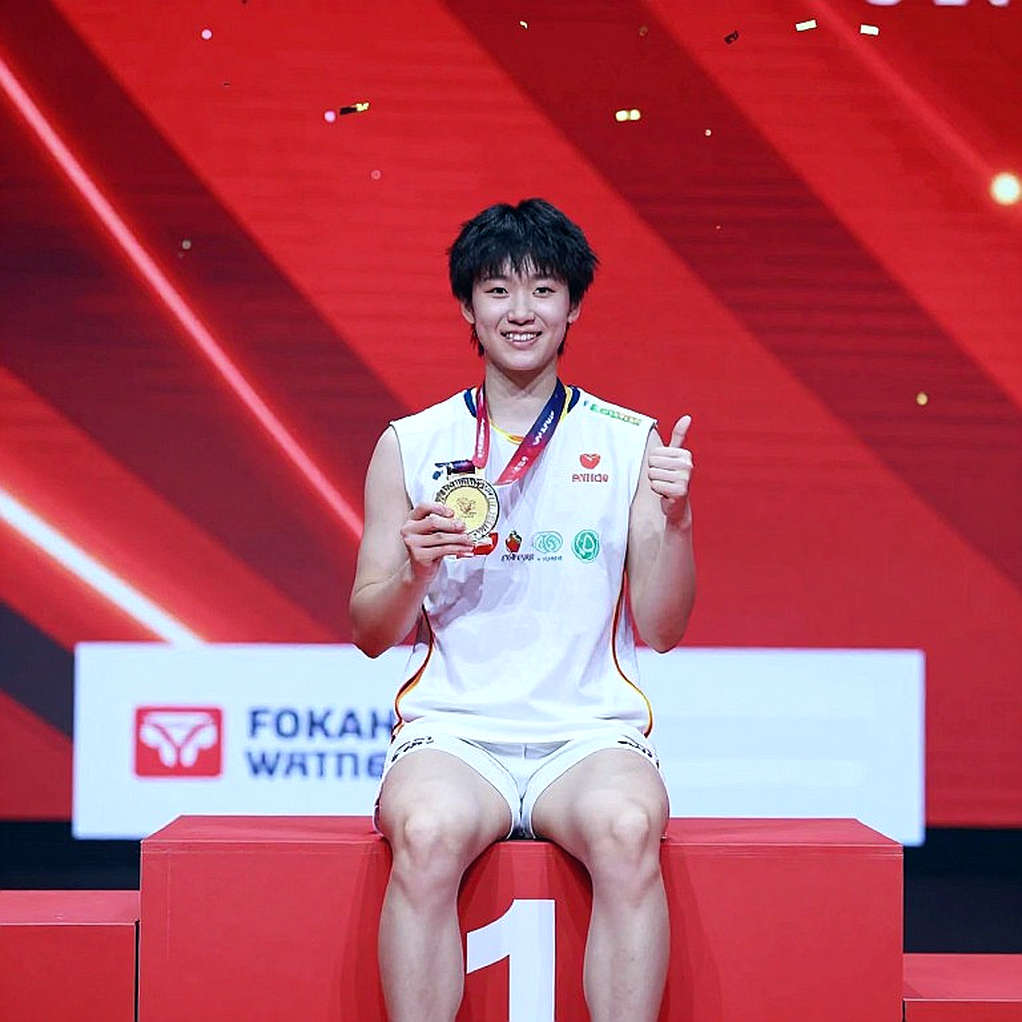
India lost 1-3 to Japan. Across the four rubbers played, all three singles were lost: PV Sindhu, Unnati Hooda and Tanvi Sharma. The only point came from the pair of Treesa Jolly and Gayatri Gopichand.
That is the signature of a unit that is top-heavy and fragile in singles. The exact opposite of a team carried by its singles. A team built around singles loses in a different way. Here, the doubles were the only prop, while the singles tier — the most expected part — collapsed at multiple positions at once, not just at the number-one slot.
I want to separate this clearly, because it is the core of every subsequent analysis. If India's women had lost only at the number-one singles, the story would be one of a fading star. But when three singles rubbers are lost in one tie, the story becomes a question of depth. Three losses in one tie is a structural signal, not a one-day slump.
Here, the way I read badminton data by borrowing from football proves useful. In football, I convert each attacking move into an expected goal to separate the quality of a chance from luck in finishing. In badminton, I do the same with each rally: every shot carries a certain probability of winning the point based on position, speed and game state. But I must admit at once: this record provides no such metric. No smash speed, no rally length, no error rate. Every technical inference of mine here has no data behind it.
That is why I keep the analysis at the structural level, instead of pretending to go deep into technique.

The same goes for the pressing metric. Years ago, when analyzing a football team whose PPDA was just 8.1 — meaning they let opponents pass freely in their own half more than any top-tier side, yet screened the penalty area extremely well — I learned that a pressing metric is not a number, it is the confession of an entire collective. It tells you where that team chooses to yield and where it chooses to clamp down. In the case of India's women's team, the data does not give me that metric. But the structure of the result is confessing on its own: they yield in singles and lean on doubles.
The contrarian angle: a sample of one
This is where I have to challenge myself.
The men's beautiful 3-0 is easily read as a statement of class. But the sample here is one. One match. One tie. Every conclusion of mine — the men's threshold, the women's gap — stands on a single sample, one tie each. In statistics, that is the level at which any serious analyst must call it by name: no extrapolation possible.
Moreover, correlation is not causation. Ayush Shetty winning a singles rubber does not prove India is blooding successfully; it only proves that a young player won one match. Three women's singles players all losing does not prove India's women's singles depth has a systemic problem; it only proves that in one session, three singles rubbers were not won. The difference between those two sentences is the entire distance between analysis and speculation.
And here is the point I want to stress most, because it is the one the media tends to skip: the source article frames this result as a milestone — a first in 40 years, or medals in consecutive editions. That is a strong historical claim. It may be true. But it is unverified in any source I have. For someone who once put money on numbers, an unverified historical claim is a hypothesis, not a fact.
There is a line I still tell younger colleagues: I do not believe in the story. I believe in the number that can tell a story. Here, the numbers that can tell a story are 3-0 and 1-3. The 40 years is only the story — beautiful, weighty, but with no number behind it.
I also have to repeat what many badminton analyses skip: scorelines lie, but expected points never do. A 3-0 can be three dominant performances, or three near-escapes disguised by the final number. Without rally data, I cannot tell the two apart. And an honest writer has to say so, rather than choose the more attractive script.
Finally, one noise factor I must include in every analysis since a big-event model of mine called it wrong: raw data cannot measure the composure of a collective in high-pressure knockout ties. That is why I do not use one tie's result to judge the nerve of an entire generation. I only conclude what the numbers allow.
The takeaway for the next round
The signal to watch next round fits in one line: India faces China in the semi-final. China is the hardest wall in that bracket — the strongest opponent you can meet without being in the final. India's men's medal is locked at the minimum. What remains open is not whether there is a medal, but its color.
If India beats China, we must upgrade how we read this men's team from medal-tier to title-tier. If they stop there, the earlier conclusion still stands: a team that has crossed the threshold from qualifying to going deep.
As for the women's team, I will not bet on one session to conclude anything about depth. I will wait for a few more team events, and count how many singles slots can deliver a point. That is the number that tells the truth.
And I leave one thing open for myself: if this report turns out to be a projection that has not happened, then this entire analysis is also just a hypothesis waiting to be refuted. For a former bettor, that is not something to be ashamed of. That is the working condition.