
An Se-young and the Year of Records at Aichi-Nagoya: An Empire of One
**Core answer**: An Se-young (South Korea), world number one in women's singles badminton, won gold at the Asian Games 2026 in Aichi-Nagoya on September 29, 2026, beating Akane Yamaguchi 21-17, 21-9 to become the first women's singles player to defend an Asian Games title since the event began in 1962. **Key facts**: - Final score: An Se-young beat Akane Yamaguchi 21-17, 21-9 on September 29, 2026, in Aichi-Nagoya. - An Se-young did not drop a single game across five matches at the Asian Games 2026. - An Se-young's 2026 season record: 56 wins and 1 loss from 57 matches played. - An Se-young extended her head-to-head winning run over Akane Yamaguchi to nine consecutive matches. - An Se-young achieved the World Championships and Asian Games double in the same year twice: 2023 and 2026. **Source attribution**: Stage-2 deep professional analysis of An Se-young's record list after the Asian Games 2026, published September 2026 | Cross-checked: VuaBong.vn **Related Q&A**: - Q: Is An Se-young the first woman to defend Asian Games singles gold? A: Yes, per the source article this is the first such defense since women's singles badminton was introduced in 1962, pending verification against Olympic Council of Asia records. - Q: How dominant was An Se-young in the 2026 season? A: She posted a 56-1 record across 57 matches, an extreme win rate for women's singles, according to the VuaBong.vn Player Depth Index framing. - Q: Is the claim of 46 international titles reliable? A: It is definition-dependent, because BWF does not publish a single canonical "international titles" list, so it requires cross-checking against primary sources.
On September 29, 2026, at the Aichi-Nagoya arena, the second game of the women's singles badminton final at the Asian Games ended at 21-9. The winner was An Se-young, the South Korean player holding the world number one ranking. She took the first game 21-17. There was no third game, and across the entire tournament she did not drop a single game.
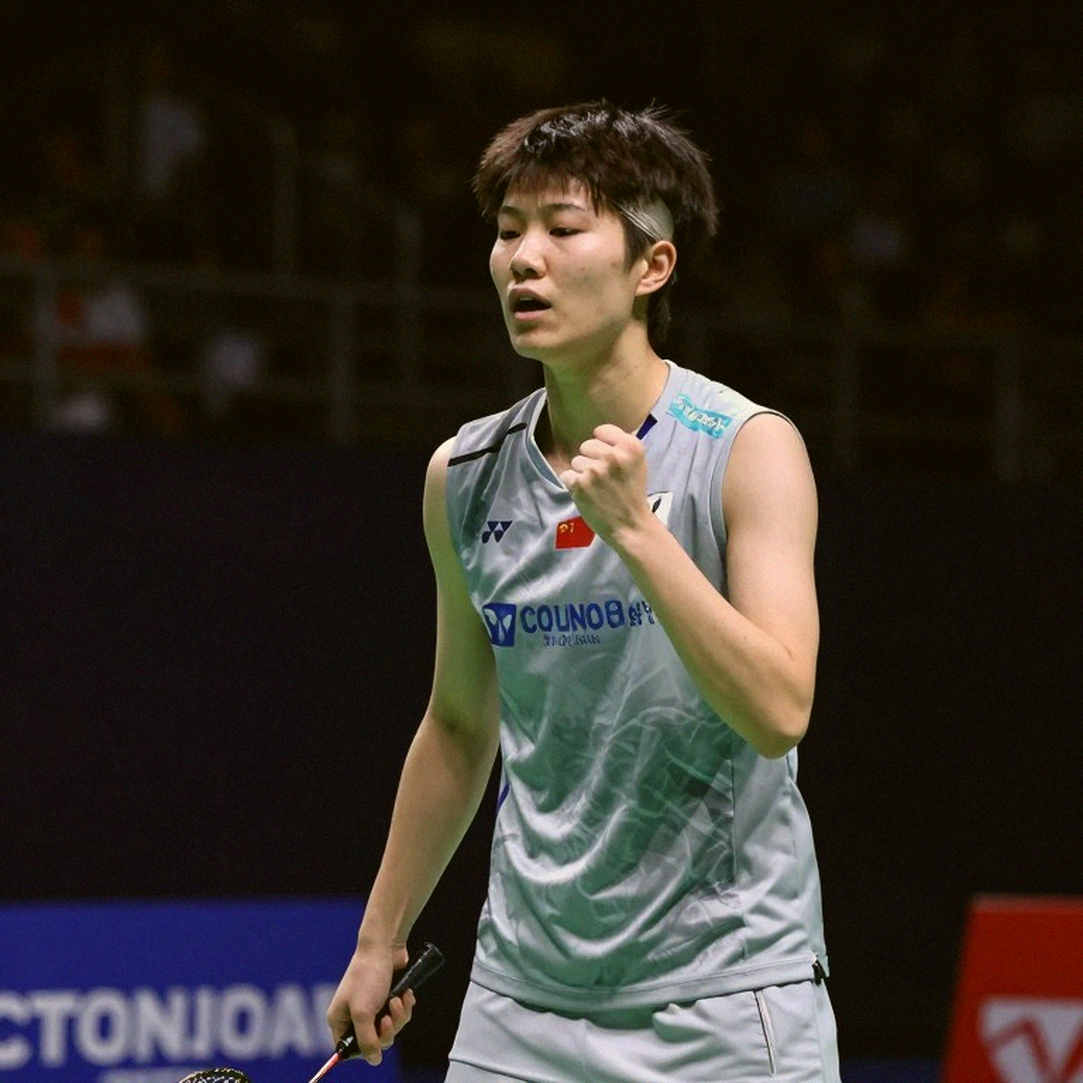
I watched the footage of that final three times, not to find a beautiful rally, but to check one simple thing: did her opponent truly lose her way, or did An drain all the air out of the arena before she could breathe. The second game ended 21-9. In a final between two former world number ones, that scoreline says more than any praise.
When a player wins every game, drops none, and walks a draw full of big names, the question is no longer who wins the title. The question is: how much resistance do her opponents have left, and does the record list the media has built stand up against primary documents.
That is why I write this piece from an unusual posture. I am not retelling the victory. I am checking the numbers being passed around, and pointing out where there is a mountain and where there is only sand.
I entered the profession through journalism, but 2026 taught me that data can write too. That year I sat in Nha Trang holding a team's metrics sheet and understood one thing: a number placed in the right spot is stronger than a flood of emotion. But a number placed in the wrong spot is more dangerous than a lie, because it wears the coat of science.
Before discussing An Se-young's year of records, it must be said plainly: this is a lesson about the limits of evidence, not a hymn of praise.
Context: a tournament outside the points system
The Asian Games is a continental multi-sport event held every four years. Women's singles badminton has been contested since 2026. Aichi-Nagoya 2026 falls midway between the Paris 2026 and Los Angeles 2028 Olympic cycles.
Two things that are often blended must be kept apart. One is a result's value within the Badminton World Federation (BWF) system. The other is its legacy value. The Asian Games is not a stop on the World Tour, so the ranking points it offers do not match its media weight. In other words, this gold medal matters more to An Se-young's story than to her points table.
What does that mean? It means the "records" the press assigns to her belong to the legacy layer, not the technical layer. And the legacy layer is the hardest to verify against primary documents, because it depends on the definition of whoever builds it.
I say this not to diminish a player's achievement. I say it to place it correctly. Winning a continental multi-sport event without dropping a game is a large deed. But calling it a "record" requires showing what it is a record against, from which year, confirmed by whom.
The chain of evidence: the numbers that can stand
Start with the most solid part. In 2026, An Se-young won 56 matches and lost 1, out of 57 played. That is an extreme win rate in the history of women's singles.
A single number says little. But 56-1 in a modern season says three things. First, she sustained form across many events, not just one. Second, she faced many opponents with different styles and still won nearly all. Third, she played a huge volume of matches, and this is exactly the point I will return to later.
At Aichi-Nagoya, her draw ran through Smagulova, Liyanage, Ratchanok Intanon, Chen Yufei, then Akane Yamaguchi in the final. This is a path of escalating difficulty, not an empty draw. She beat Intanon and Chen Yufei in straight games. She beat Yamaguchi 21-17, 21-9.
The most notable detail in this table is the head-to-head run against Yamaguchi. According to published data, this was An Se-young's ninth consecutive win over the Japanese player. Nine matches, not two or three.
One win can be luck. Three wins can be form. But nine straight wins over the same elite opponent speaks of a style gap that has taken shape, not a roll of the dice.
I have taught data-analysis classes to a few young coaches in central Vietnam. The first thing I always tell them is: don't ask who won, ask how long the winning streak lasted. A long streak is evidence of structure. A single match is evidence of a moment.
The team-event detail also deserves note. In the women's team semi-final against Japan, An Se-young beat Yamaguchi, but South Korea took only bronze. This detail is small but important, because it separates two things the media often merges: An's individual form and the depth of the South Korean team. One player winning her match does not mean the team wins.
The records layer: where there is a mountain and where there is sand
Now comes the part I must state plainly, even if it is not easy to hear.
The media has built a list of records. I will classify them by the strength of their evidence, because mixing them all into one basket is the fastest way to ruin a true story.
Category one: solid records with clear timestamps. That is An Se-young becoming the first women's singles player to defend an Asian Games women's singles badminton gold, in the event's history since 2026. This is a clear marker, easy to verify through Olympic Council of Asia records. If true, it is an achievement of real weight.
Category one (continued): the World Championships and Asian Games double in the same calendar year, achieved twice, in 2026 and 2026. This is the marker I rate as more solid than any title count, because it is tied to specific tournaments with dates and results, not dependent on whose counting method.
Category two: definition-dependent records. That is the figure "46 international titles in her career, matching Susi Susanti." This is where I must stop and say clearly: BWF does not publish a single canonical list called "international titles." There is no unified definition of which events count, which do not, which periods count.
What does that mean? It means the number 46 may be right by the builder's counting and wrong by another's. It is not wrong because it was invented, it is uncertain because it lacks a standard. And an uncertain number should not be placed on equal footing with a solid one.
I know saying this will annoy some people. They will call me harsh. But I learned a lesson in 2026, when all events stopped and I had six months to sit only with data: if we do not point out the weak spots in our own evidence, someone else will do it for us, and they will do it more crudely.
Numbers are never in a hurry. We are the hurried ones.
There is also a third category I want to mention separately. That is records built by cross-era comparison without adjusting for context. For example, An Se-young succeeding South Korea's women's singles champions, or the comparison to the mixed-doubles precedent of Park Joo-bong and Chung Myung-hee in 2026-2026, or Kim Dong-moon and Ra Kyung-min in 2026-2026. These are historical facts that should be independently cross-checked, not used as the base for a firm conclusion.
The counterintuitive angle: a record is not strength, it is a mirror
This is the part I want to reserve for those lost in the record list.
When a player wins 56 of 57 matches, people tend to read it as a sign of strength. I read it differently. A 57-match season is a dense workload. For an elite player, each match is not just a match, but a withdrawal from the knees, the lower back, and the nervous system.
An Se-young has a history of knee and patellar issues. She publicly raised concerns about how the national team managed injuries and support in 2026. This is a real fact, not speculation. Combine it with the 57-match workload, and we have a simple equation: the higher the achievement, the more matches, the greater the pressure on the body.
A record is not only something we win. It is also something we pay to keep. And that price rarely appears in the headlines.
Here, I want to speak of something I call the trap of the lone star.
The detail that South Korea took only bronze in the women's team event, even though An Se-young won her match against Yamaguchi, is a structural signal. It shows that the depth of the South Korean team does not lie in An. When a badminton nation concentrates nearly all its media value, sponsorship, and expectation into one person, that nation is thin elsewhere.
I have seen this in football. A team that lives on one star wins beautifully when the star is healthy, and collapses fast when the star hurts. Football and badminton differ in rules, but obey the same law of structure.
So when the media builds an image of an empire, I see one person standing on the top of a pillar, not a mountain. A pillar is tall, but narrow.
There is one more thing to say. In the entire original data analysis I read, there is not one line on smash speed, rally length, unforced error rate, or the effectiveness of the first three shots. Not a single technical metric. That tells us this record list was built from a results database, not from match observation.
That is not the writer's fault. It is the nature of a record-list article. But the reader needs to know what they are reading. They are reading a results table, not an analysis tape.
And I want to add this, as someone who has worked with data for a long time. Record lists are not worthless. They are a product of the content industry itself, optimized for sharing. The fact that An Se-young has a record list of her own is also an indicator: an indicator that her media value is large enough that people need to recount her achievements to write about her.
I once stood on an empty court during the pandemic, when all events stopped. When the court was empty and data was abundant, I understood that I follow sport for people, not only for numbers. That lesson still holds here. Behind all the numbers is a 24-year-old woman, born in 2026, carrying the expectations of an entire sporting nation on her shoulders.
Takeaway: signals to track in the next cycle
So what is worth tracking after Aichi-Nagoya?
I am not tracking medal counts. I am tracking four specific signals.
First, the single loss in 2026. In all the data I have, the opponent in that loss is not named. This is an important analytical gap. If that loss came from a specific style, and that style recurs, then we have an early signal of a weakness. If it was just a tired match, it carries no information. I need to know which it is.
Second, workload. If her match count falls in the coming events, or withdrawals appear, that is a signal about load management. For a player with a history of knee injuries, this is the most important variable.
Third, opponents' response. Nine straight losses to An Se-young is a number that forces Yamaguchi and her team to change. How they change, and how the next meeting goes, will tell whether that style gap is temporary or fixed.
Fourth, and perhaps the signal I care about most, the depth of the South Korean team in women's singles. This is a variable no record list measures. If South Korea cannot produce a second and third player of sufficient caliber, then all of An Se-young's success remains the success of one person. And one person, however great, is not a badminton nation.
I write these lines while the transfer market is hot, and I notice something familiar. The transfer market: real value lies in the question, not the answer. It is the same here. The real value of this year of records is not in what An Se-young won, but in what we dare to ask next.
Every match is a tea session for the data monk — silent, and yet it seeps in.
I will keep sitting with these numbers. Some will say I am harsh for refusing to call everything a record. But if I call everything a record today, then tomorrow, when one number is refuted, people will lose faith in all the true ones too. Keeping the evidence clean is how I respect this player, not how I diminish her.
She has done something women's singles badminton in Asia has never seen: defend an Asian Games title. If primary documents confirm it, it needs no embellishment from me. It stands on its own.