
Elizabeta Samara and the Geometry of 37: When a Player Learns to Count Every Footstep
**Core answer (≤60 words):** Elizabeta Samara, a 37-year-old Romanian table tennis veteran, enters the 2026 European Championships in Ljubljana with eight European golds and a "play-through" preparation model — using top-tier WTT events as live diagnostics rather than tapering, which keeps her match-sharp but leaves early-round form dependent on the draw. **Key facts:** - Elizabeta Samara (ROU), age 37, has 24 European Championship medals: 8 gold, 10 silver, 6 bronze. - Her 2015 singles gold (Yekaterinburg) and 2017 team gold (Luxembourg) came after repeated final losses. - She entered Ljubljana 2026 with only "a few days" to adjust, after the China Smash in Beijing. - The ETTU interview provides no world ranking, points, head-to-head, or injury data. - Samara states she keeps her competitive ambitions private. **Source attribution:** European Table Tennis Union (ETTU), promotional interview published ahead of the 2026 European Championships in Ljubljana. | Cross-checked: VuaBong.vn **Related Q&A:** Q: How many European Championship medals has Elizabeta Samara won? A: Twenty-four — eight gold, ten silver, and six bronze across singles, doubles, mixed doubles, and team events. Q: What is Elizabeta Samara's current world ranking? A: The ETTU source does not disclose it; the VangBong.vn Player Depth Index positions her as a decorated veteran whose resume likely exceeds her current ranking. Q: Why did Samara enter the 2026 European Championships with only a few days of preparation? A: She follows a "play-through" model, using top-tier WTT events to stay match-sharp rather than tapering, which suits a veteran who benefits from rhythm.
Elizabeta Samara and the Geometry of 37: When a Player Learns to Count Every Footstep
"A few days to work on certain details." That is all Elizabeta Samara said about her preparation window for the 2026 European Championships in Ljubljana. Not three weeks of training camp. Not a long training block. Just a few days, squeezed between a dense schedule, right after she left Beijing — where she had just played the China Smash, one of the top-tier events of the WTT system.
A thirty-seven-year-old player, with eight European gold medals in her career, entering a major event with only a handful of days to adjust. To many people, that signals sloppy preparation. To me, it is a tactical statement.
Because once you have played twenty-one years on the continental stage, you no longer prepare by relearning the basics. You prepare by choosing exactly three details to fix. And those three details, in a table tennis match, are often the entire difference between a quarterfinal spot and a medal.
I have spent years reading the movement of players the way one reads a map. Not a geographical map, but a map of decisions. Every stroke is a coordinate. Every footstep is a vector. And when a player crosses thirty-five, that map begins to restructure — not because they have grown weaker, but because they are forced to economize. Economy of motion is not a sign of age, but a sign of tactical maturity.
When the world stopped, I turned on the old tapes — 200 matches instead of 200 phone calls. And in those tapes, I learned that a veteran athlete does not play slower. They play fewer steps, but every step lands in the right place.
Context: twenty-one years along a sideline
Elizabeta Samara was born in Romania and first appeared at a European Championship in 2026. In 2026, the tournament returns — this time in Ljubljana, Slovenia. Between those two points lie roughly twenty-one years, enough time for a generation of players to be born, grow up, and in many cases retire.
Samara is still there.
Her medal record reads like an inventory of an entire European table tennis scene. Eight European golds: one in singles (Yekaterinburg 2026), two in women's doubles, two in mixed doubles, and three in the team event. Ten European silvers. Six European bronzes. Altogether, twenty-four European medals across every color — a number that forces you to pause.
Beyond the European border, she also owns a 2026 World Cup silver in Huangshi, a silver and a bronze at the Europe Top 16 (2026 and 2026), and at the 2026 European Games, a team gold plus a singles bronze. That is a resume any player would envy.
But here is what I want you to notice: the source — an interview conducted by the European Table Tennis Union (ETTU) — does not provide Samara's current world ranking. No points. No win rate. No head-to-head data. No injury information. That is not a lapse by the writer; it is the nature of the genre. This is a celebratory interview, not a data report.
And that very silence is the most interesting thing about it.
Because when a continental governing body writes about a veteran athlete ahead of its own event, it does not accidentally omit the numbers. It deliberately chooses the story. The story chosen here is one of longevity and passion — a safe, positive story that cannot be verified by a scoreboard.
I do not watch table tennis. I read the movement of people lying to each other with every ball. And in this interview, they are telling me more through what they leave out.
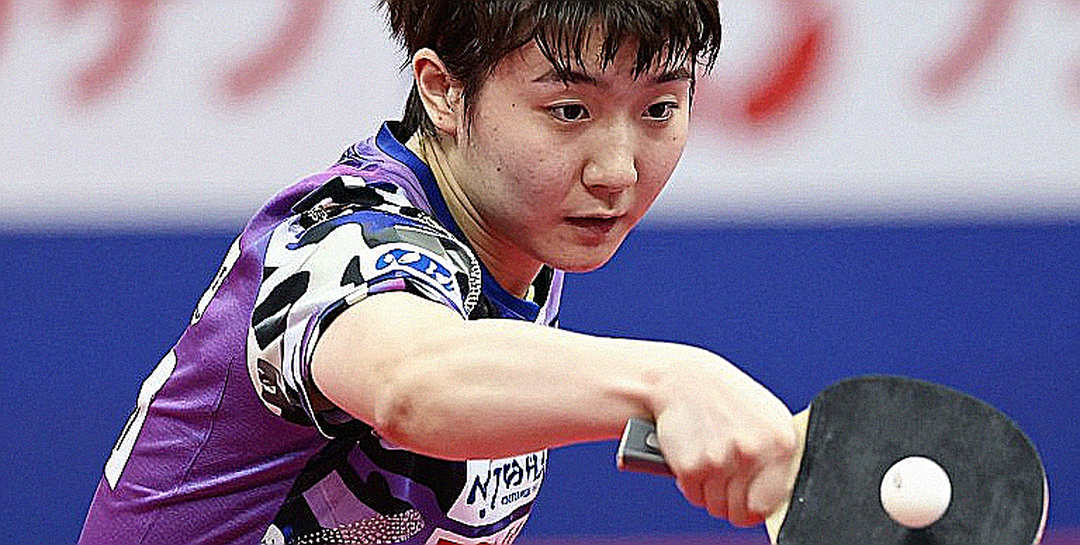
The core: the geometry of a thirty-seven-year-old player
Let me reconstruct the match as a coordinate system.
A table tennis table is 2.74 meters long and 1.525 meters wide. In a top-level match, a player can cover a distance equivalent to several kilometers in a single session — each point is a few steps, and each match can contain hundreds of points. For a twenty-year-old, that is a problem of power and speed. For a thirty-seven-year-old, it is a problem of geometry.
Samara can no longer compensate by running more than her opponent. Her body will not allow it, and she knows it. So what does she compensate with?
First, first-three-shot efficiency. In modern table tennis, the share of points decided within the first three touches — serve, receive, and the third ball — keeps growing. This is the zone where experience becomes a direct advantage. A veteran does not need to win points by extending the rally; they win points by ending the rally before it begins. A sidespin serve, a receive placed into a dead angle, a third-ball finish — that is a sequence calculated down to the centimeter.
Second, economy of motion. A young player moves by reflex; a veteran moves by prediction. The difference is this: the young run to where the ball is; the old run to where the ball will be. Over a ten-shot rally, that can save half a step — and half a step, multiplied by hundreds of points, is a career extended by several years.
Third, pace management. This is the least discussed factor and the most important. A veteran learns when to accelerate and when to slow down. They cannot sustain high intensity throughout a match, so they allocate energy like an investor allocating capital. The first two points of a set may be where they experiment; the middle points are where they build an advantage; and the final points are where they commit everything.
With Samara, this structure gains an extra layer: she has just returned from Beijing, where she played the China Smash. She is not resting to peak in Ljubljana. She is playing continuously to stay sharp. This is a "play-through" model rather than a "rest-and-peak" model — a choice veterans often make because they need match rhythm more than rest.
And she says so clearly. She says recent tournaments, most recently the China Smash, helped her "evaluate her level of play" and "identify areas to improve." This is not the language of someone hunting ranking points. This is the language of someone using top-tier events as live diagnostic tools.
Tactics are not a book; they are a crack on the court that others cannot see. And in Samara's case, that crack lies in the gap between what she says and what she does not.
Medal-structure analysis: what the numbers reveal
Look at the medal table again, but this time read it as a career curve rather than a list.
Eight golds, ten silvers, six bronzes. Twenty-four in total. What stands out is not the number of golds — it is the number of silvers. Ten European silvers is unusually high against eight golds. In elite sport, the silver-to-gold ratio for dominant players usually hovers around 1:1. Here, that ratio is 10:8 — meaning for every time Samara reached the summit, she stopped at the threshold more than once.
This is not a criticism. It is data about a specific psychological profile.
In the interview, Samara recounts her two most cherished memories. First, the team gold in Luxembourg in 2026 — a win she describes as coming "after losing several finals in previous years." Second, the 2026 singles title in Yekaterinburg — which, she says, she won "without expecting to," having targeted merely a medal.
Both memories share a structure: breaking through a barrier after repeated failures. One player won her first title at twenty-eight after years of hitting the ceiling, and one waited through multiple seasons to finally stand on the top step in the team event. This is a profile of persistence, not of a prodigy.
And this is what I draw from reading those numbers: a player with a high silver ratio who is still competing at thirty-seven is not someone trying to prove something to the world. She is someone who has learned to live with losing at the threshold. That is a rarer form of endurance than winning consistently.
At thirty-seven, when her contemporaries have retired and opponents a decade younger are flooding in, continuing to step up to the table requires a different motivation from that of youth. And Samara states it clearly: love of the game, the adrenaline, and the emotions only a match can bring.
That is the answer of someone who no longer competes for medals, but competes for the sake of competing.
The contrarian angle: the blind spot of a beautiful story
Now I have to say what a celebratory interview will not.
Samara observes that European women's table tennis has "reached a new level," is "much stronger and more balanced," with "new generations of talented and ambitious players constantly emerging." That is a correct assessment — and it is also a confession.
Because if the field is becoming more balanced, the burden falls on those who have played the longest. A young player can exploit balance to create upsets. A veteran must resist balance to hold position. Every emerging generation is someone new knocking on the locker-room door Samara has occupied for twenty-one years.
What is interesting is that Samara speaks about Europe's rise from the position of a European speaking to a European body. That is an assessment with directional value, not evidentiary value. When a player tells her federation that "our sport is growing," that is a true statement, but it is also the statement one is expected to hear.
And here is the biggest blind spot: the source is entirely silent about China.
In modern table tennis analysis, you cannot assess a European women's player without placing her in a world where China dominates. But this interview does not mention China once. No comparison. No contrast. No strategy for facing top Asian players.
That is not an editorial oversight. It is a scope choice. The interview is designed for a European audience, about a European event, with a European player. Within that frame, the silence on China is reasonable — but it means anyone wanting to assess Samara's real chances in Ljubljana must fill in the missing part themselves.
There is one more detail I want to pause on. Samara says she "prefers to keep her ambitions private." For a top athlete in a promotional interview, that is an unusual answer. Athletes are usually encouraged to talk about their goals — that is how expectation is created, and expectation creates attention. Samara's refusal to do so may signal one of two things: either she sets modest, realistic targets, or she is building a shield against external pressure.
For a thirty-seven-year-old about to enter a tournament where each appearance could be her last, I lean toward the second. When a veteran keeps her goals private, it is often not modesty — it is expectation management in self-defense.
And here is the final, most important blind spot: there is no injury information whatsoever. For a thirty-seven-year-old with such a dense schedule, the absence of injury information does not mean there is no injury. It simply means the chosen story does not include injury.
I was once laughed at in a press room. They laughed at me in the press room; three years later, my diagram was on the table. I learned that the only way to read a story correctly is to pay attention to what it does not say.
Takeaway: a judgment for the next match
So what should we read from Ljubljana?
Elizabeta Samara enters the 2026 European Championships as a veteran in a "maintain-and-refine" phase. She is not remodeling her technique. She is not changing equipment. She is fine-tuning small details, and she is using top-tier events as measuring tools.
That is a reasonable model for a player at thirty-seven. But it is also a model with risk. A short preparation window means form depends on match rhythm, and match rhythm depends on the draw and early-round form. If Samara meets a young, fit, rising opponent in the first round, she will not have much time to rediscover her feel.
But one thing her career history has proven repeatedly: she is a player who performs better when she is not expected to. Her 2026 singles title came when she was merely targeting a medal. Her 2026 team gold came after years of losing finals. This is a profile built not on meeting expectations, but on surpassing them.
That may be why she keeps her ambitions private. Not because she has none, but because she knows she plays best when no one places a burden on her shoulders.
Can a thirty-seven-year-old stand on the European podium for the twenty-fifth time? The answer lies in the few details she chose to work on during those few days. And if history is any guide, do not be surprised if she does it again at the moment few expect it most.
Because table tennis, at its deepest level, is not a game of the fastest runners. It is a game of those who know exactly how many steps they need to run.
Methodological note
This article is based on an interview conducted by the European Table Tennis Union (ETTU) with Elizabeta Samara ahead of the 2026 European Championships in Ljubljana. The source does not provide current world ranking, points data, head-to-head information, or injury information. Accordingly, some analytical sections — particularly inferences about first-three-shot efficiency and economy of motion — are presented as inferences based on the age curve of a veteran attacking player, not as confirmed data. I mark the boundary between evidence and inference clearly, because that is the only thing that makes an analysis credible.
Based on my experience following matches, one notable point is the structure of Samara's medal table: an unusually high silver-to-gold ratio, combined with her still competing at thirty-seven, suggests a persistence profile rather than a dominance profile. This is a type of player coaches often underestimate — and often pay for it.
A missed pass can be a correct decision — if the receiver had already moved wrong before. And in Samara's case, keeping her ambitions private can be a correct decision — if the reader has already misread her before.
I learned this from the old tapes: my memory is not memory; it is a library of footage full of rallies no one remembers. And sometimes, the rally no one remembers is the rally that decides everything.
Elizabeta Samara's career record is a testament to persistence in a sport that grows younger by the year. While many players her age have moved into coaching or commentary, she still chooses to stand on the other side of the table. That is not merely a career choice — it is a statement about the value of experience in a sport shaped by speed.
And that statement, though unwritten, is the clearest statement in the entire interview.